
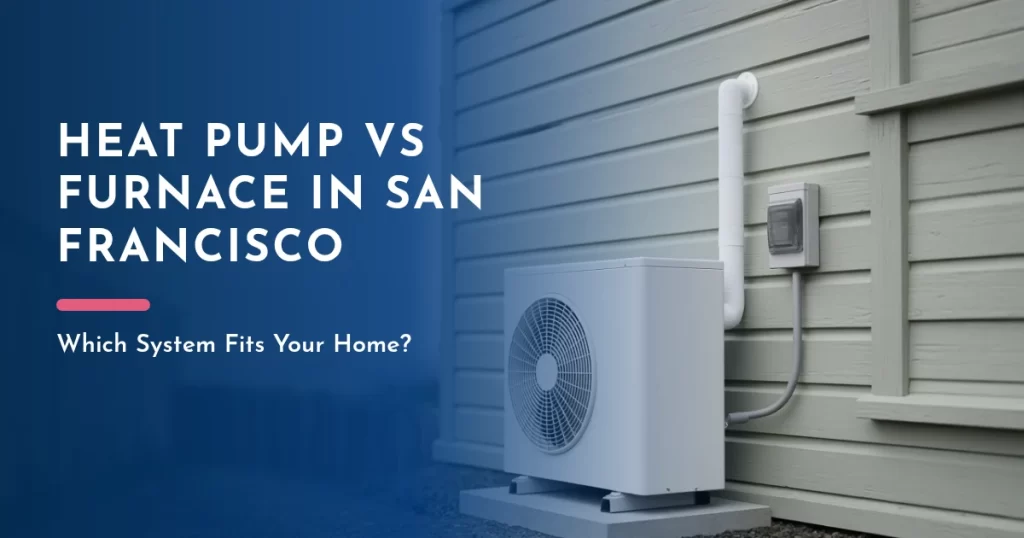
For most San Francisco homes, the choice between a heat pump and a gas furnace comes down to three practical questions. Does the house have ducts? Can the electrical panel take another large load? And do you want cooling as well as heat? San Francisco’s mild, cool climate suits heat pumps well, and Bay Area air rules are moving away from gas furnaces. Still, a furnace can be the simpler choice for some homes. This guide explains the trade-offs without the sales pitch.
How each system makes heat
A gas furnace burns natural gas and blows the heated air through ducts. It produces heat quickly and doesn’t depend on the outdoor temperature.
A heat pump doesn’t burn anything. It uses refrigerant and a compressor to move heat from the outdoor air into your home, the same way an air conditioner moves heat out in summer. Because it moves heat instead of making it, it can deliver more heat energy than it uses in electricity. It also cools, so one system covers both seasons.
Heat pumps come in two main forms:
- Ducted (central): an outdoor unit paired with an indoor air handler that uses your existing ducts
- Ductless mini-split: an outdoor unit connected to wall or ceiling units in individual rooms, with no ducts needed
Why the climate here favors heat pumps
Heat pumps lose some efficiency in deep cold, which is why people in snowy regions sometimes keep a furnace as backup. San Francisco rarely sees that kind of cold. Winters are cool and damp rather than freezing, and many neighborhoods need some heat in much of the year. That steady, moderate demand is where a heat pump performs well.
Cooling is the other side. Many San Francisco homes have no air conditioning at all, and a run of warm days in early fall can make upstairs rooms uncomfortable. A heat pump gives you cooling for those days without adding a second system. For model choices suited to this kind of weather, see our post on high-efficiency heat pumps for coastal climates.
Side-by-side comparison
| Factor | Heat pump | Gas furnace |
|---|---|---|
| Fuel | Electricity | Natural gas |
| Cooling | Yes, same system | No, needs a separate AC |
| Ducts | Ducted or ductless options | Needs ducts (wall and floor furnaces aside) |
| Electrical needs | May need a new circuit or panel upgrade | Small electrical load |
| On-site combustion | None | Yes, needs venting and a CO alarm |
| Bay Area air rules | Not affected | New furnaces must be zero-NOx from 2029 under current rules |
| Comfort | Steady, even heat | Quick, hot bursts of air |
| Upkeep | Filter changes, coil and outdoor unit care | Filter changes, burner and venting checks |
Ducts: the first question to answer

If your home has ducts in good shape, a ducted heat pump can often connect to them. The ducts need to be checked for size, leaks and insulation first, because heat pumps deliver air that’s warm rather than hot. Undersized or leaky ducts can make the house feel drafty.
If your home has no ducts, a ductless mini-split usually makes more sense than adding ductwork. Many older homes and flats were built with wall furnaces, floor furnaces or radiators instead of central ducts. A mini-split can heat and cool the main rooms without opening walls for ducts. See our ductless mini-split installation page for how that works.
If you have a wall or floor furnace, a straight replacement with another gas unit is limited by the same air rules as central furnaces. That makes it a natural point to consider a mini-split.
Electrical capacity
A heat pump runs on electricity, so your panel has to handle it. Older homes sometimes have small panels already near their limit. A technician should check the panel and the available circuit space as part of the quote. If you’re also planning an EV charger, an induction range or a heat pump water heater, plan the panel for all of them together.
Bay Area air rules and gas furnaces
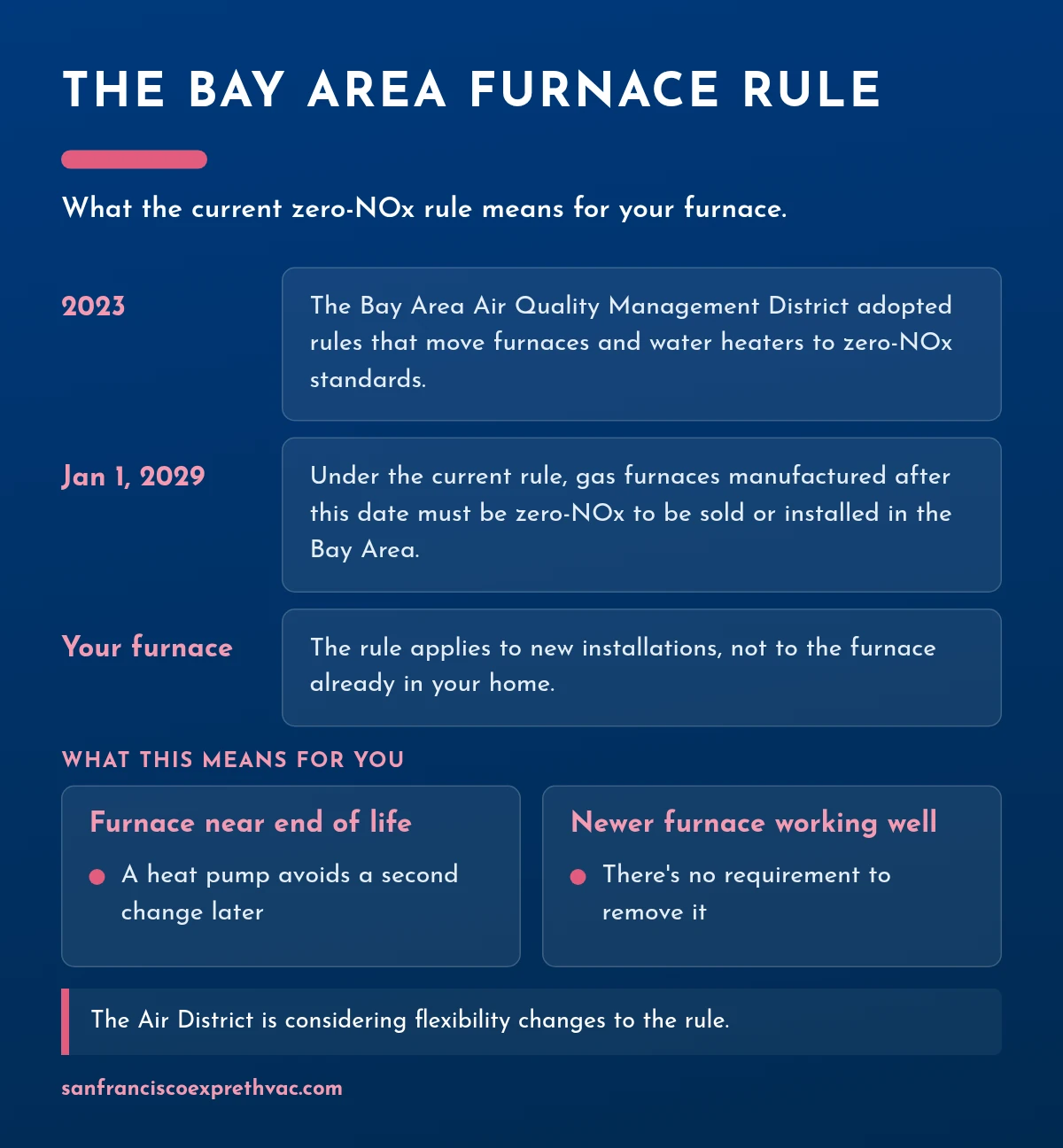
The Bay Area Air Quality Management District adopted rules in 2023 that move furnaces and water heaters to zero-NOx standards. Under the current rule, gas furnaces manufactured after January 1, 2029, must be zero-NOx to be sold or installed in the Bay Area. Right now, that effectively means electric. The rule applies to new installations, not to the furnace already in your home, and the Air District is considering flexibility changes. Our zero-NOx furnace guide covers the details.
What this means for you: if your furnace is near the end of its life, a heat pump avoids a second change later. If your furnace is newer and working well, there’s no requirement to remove it.
When a furnace still makes sense
A gas furnace can still be the better fit when:
- Your furnace is fairly new and only needs a repair
- Your electrical panel can’t support a heat pump yet and an upgrade isn’t practical now
- You want to keep heat-only service and don’t need cooling
A hybrid, or dual-fuel, setup is another option. A heat pump handles most of the heating and the furnace runs only when needed. Read our page on hybrid heating system installation to see how it’s set up.
Rebates and incentives
Heat pump incentives in California change during the year, and some depend on your utility or income. Check the current programs before you sign a contract. Our heat pump rebates guide for San Francisco homeowners lists the main ones, and your installer should confirm which ones apply to the equipment in your quote.
Quick checklist for your home
- Does the home have ducts, and what condition are they in?
- How old is the current furnace, and is it working?
- Do you want cooling on warm days?
- How large is your electrical panel, and how much room is left?
- Are you planning other electric upgrades in the next few years?
- Which rooms are hardest to keep comfortable now?
Frequently asked questions
Can a heat pump heat a San Francisco home on its own?
Yes, for most homes. San Francisco’s winters are mild, which is the range where heat pumps work efficiently. Sizing and duct condition matter more than the weather here.
Do I have to replace my gas furnace?
No. The Bay Area zero-NOx rule applies to new furnaces sold or installed after its compliance date. A working furnace can stay in service and be repaired.
Is a heat pump cheaper to run than a gas furnace?
It depends on your electricity and gas rates, the efficiency of each system and how well the home holds heat. Ask your installer to compare operating costs for your home using your current utility rates.
Will a heat pump work with my old ducts?
Often, but the ducts need to be checked first. Heat pumps move more air at lower temperatures, so undersized, leaky or uninsulated ducts can cause drafts and weak heat.
What if I live in a flat with no ducts?
A ductless mini-split is usually the best fit. It needs a spot for the outdoor unit and a path for a small line set, so building or HOA approval may be needed.
Talk through the options for your home
San Francisco Expert Heating and Air can look at your ducts, panel and current system and explain which option fits. See our furnace and heating installation and heating and furnace repair services. We’re at 1725 Montgomery St, San Francisco, CA 94111. Call (415) 371-9413.