

Table of Contents
- Mini Split Brands to Avoid in San Francisco
- What Determines a Mini Split Brand's Reliability
- Why Reliable Mini Split Brands Pay Off
- How Mini Split Performance Relates to Brand Choice
- Best Practices for Evaluating Mini Split Brands
- Making a Confident Choice for Your San Francisco Home
Mini Split Brands to Avoid in San Francisco
The answer to what mini split brands to stay away from in San Francisco lies not in a list of names but in recognizing red flags that indicate a system may fail early or cost more in repairs. This guide helps San Francisco homeowners spot those warning signs, so you can choose a mini split that will perform reliably in our climate without relying on unverified brand reputation alone.
Choosing the wrong system can mean poor efficiency, frequent breakdowns, and higher long-term costs, problems that hit harder in San Francisco’s varied microclimates, where one neighborhood may be shrouded in fog while another basks in afternoon sun. In San Francisco, it’s possible for a block to experience heavy fog while just around the corner lies blazing afternoon sunshine. A unit that cannot handle these shifts can waste energy and shorten its useful life.
We have spent almost thirty years serving homes across San Francisco, which has taught us that durability does not come from the manufacturer’s reputation alone, but rather depends on the right combination of proper siting, correct sizing, and quality installation. The foundation for any mini-split system lies here. Once you understand how each component contributes to the success of the system, you’ll be able to avoid being disappointed regardless of what brand was used.
Key Takeaways
- There are three primary reasons why some mini-split brands might be more dependable than others.
- A reliable mini split brand delivers immediate reductions in monthly energy use through advanced inverter technology.
- The longevity of a minisplit system depends on three things: the quality of its parts, how well it has been installed, and the way that you care for it each day.
- Choosing a ductless mini split system means committing to equipment that will heat and cool your home for years.
- Choosing a mini split system for your San Francisco home becomes straightforward once you understand what mini split brands to stay away from in San Francisco.
What Determines a Mini Split Brand’s Reliability
There are three primary reasons why some mini-split brands might be more dependable than others. They include the manufacturer’s quality of production, the materials used in construction, and the strength of their service networks. To find out which brands have dependable mini-splits available for purchase here in San Francisco requires doing our homework rather than relying just on the sales pitch. There are several elements about a certain brand that will determine whether they’re truly reliable or merely another expensive problem waiting to happen.
Manufacturing Origin and Quality Control
The place where mini-splits are manufactured often has bearing on what kind of quality controls they are subjected to. Japanese manufacturers such as Mitsubishi and Daikin typically follow rigorous testing protocols, ensuring each unit meets consistent performance standards before leaving the factory. Each unit has to pass certain criteria before it leaves the factory, while other machines may be less consistent regarding component quality and how components are fitted together. In contrast, some Chinese-made units may experience greater variation in component quality and assembly precision, even though many factories continue to raise their standards. There isn’t necessarily anything worse coming out from the factory; just different degrees of emphasis upon things like making sure there won’t be defects later, which helps them last longer if used properly.
Red Flags: Brands with High Failure Rates
If your potential vendor seems to be untrustworthy, there are several things they could end up doing that will tell you beforehand. These include:
- Warranties limited to one year or covering only a handful of parts, which signals the manufacturer’s own lack of confidence in the product.
- A pattern of poor customer reviews citing repeated breakdowns, noisy operation, or difficulty getting warranty service.
- No authorized distributors or parts depots in the United States, making it nearly impossible to obtain replacement components quickly.
- A weak or completely absent network of trained service technicians, leaving you to handle repairs on a unit that few local professionals are willing to touch.
If any of these red flags appear together, the brand’s true cost will almost certainly exceed its low sticker price.
Comparing Build Quality: Materials and Testing Standards
Trusted companies build their units with copper coils and high-quality UV-resistant plastics designed to resist years of temperature fluctuations and weather-related wear-and-tear. These components are then submitted to stress tests such as salt-spray chambers for coastal environments, freeze-cycle tests in freezing climates, and long-term testing to find any weaknesses before they ship products off to customers. Inferior-quality brands may use cheaper materials like aluminum coils that corrode faster and thinner plastics that become brittle in direct sunlight. Beyond the hardware itself, a strong parts and service network is another clear sign of reliability. Companies that have authorized distributors on hand in the U.S., as well as a wide base of trained technicians, mean you can expect faster, more affordable support if something goes wrong.
Focusing only on first-cost savings may be a bad idea because you’ll end up paying more for repairs than you saved at the time of purchase. Focus instead on brands that have rigorous quality controls, use high-quality materials, and provide readily available service if you live anywhere near San Francisco. Doing this keeps your home comfortable while reducing the likelihood of unexpected breakdowns and the expenses that come with them.
Why Reliable Mini Split Brands Pay Off
Lower Energy Costs and Better Value
A reliable mini split brand delivers immediate reductions in monthly energy use through advanced inverter technology. Instead of cycling on and off at full power, these systems adjust compressor speed precisely to the room’s demand, using only the electricity needed to maintain a steady temperature. Our clients in San Francisco often see the impact on their utility bill within the first full month of operation. While a premium system may involve a higher initial investment, the month-over-month savings quickly add up, making it a far better long-term value than budget alternatives. Brands like Mitsubishi and Daikin have refined this technology over decades, producing systems that outperform generic models in both efficiency and consistency. For homeowners who prioritize lower operating costs and environmental responsibility, choosing a trusted brand translates directly into tangible savings and peace of mind.
Quieter, More Comfortable Living Spaces
They care about sound too, making them an excellent choice for bedrooms, home office spaces, and living room areas where people gather together. They incorporate insulated compressor compartments, vibration-absorbing mounts, and aerodynamically optimized fan blades so the units operate at levels that are barely perceptible—especially valuable in a compact San Francisco home where a noisy appliance can disrupt an entire floor. We work closely with local customers to select models that deliver the quiet performance needed for restful sleep or focused work. Mitsubishi and Daikin both employ noise reduction techniques to keep their indoor components from being noisy, well below what you find in cheap systems. This quiet operation is not just a luxury; it directly enhances day-to-day comfort and overall satisfaction with the system. When you can’t even tell the system is running, you’ve found a design that truly respects your living environment.
Increased System Lifespan and Fewer Repairs
Another thing that will tell if you have a well-built mini-split HVAC unit is its durability. The components, such as the compressor, coil, and control board in high-quality brands, are built to withstand years of heavy use, minimizing the chance of unexpected failures. As a result, if you own a busy home in San Francisco, that reliability translates into fewer service disruptions and lower cumulative repair costs over the life of the equipment. Each of these systems needs regular maintenance, but we find that units made by companies such as Mitsubishi or Daikin spend far less time needing repairs than lesser-known alternatives. When homeowners opt for a company that’s known to produce good units from the beginning, they can save both cash and frustration. Our experience has shown us that this is also true about having a mini-split HVAC installed in a home. Quality is the key factor here because, in most cases, it pays off with better and higher system life expectancy.
Understanding these benefits helps frame how brand choice directly impacts performance.
How Mini Split Performance Relates to Brand Choice
The longevity of a minisplit system depends on three things: the quality of its parts, how well it has been installed, and the way that you care for it each day. The brand of your system will make quite a difference when it comes to the first issue; however, even the best components won’t compensate for poor installation or misuse.
The Core Components That Affect Reliability
In contrast to the air conditioner system’s heart, the compressor, the brand choice determines if it includes inverter technology that varies the speed to fit the load. Inverters on the compressor vary their speed to match demand, reducing wear, smoothing temperature swings, and lowering energy use compared to fixed-speed models. The coil used for the refrigerant can differ between manufacturers, as well. Copper coils tend to have a better heat transfer rate and can withstand more corrosion than aluminum. This can be a big deal if you live near an area with salt air, such as San Francisco, since it is corrosive, and accelerates deterioration more quickly. There are several differences regarding electronic control board and sensor capabilities. Higher tier brands make circuitry more resilient against voltage changes, moisture, and less prone to failure because they are built out stronger than lower-end systems. Look into the compressor types, coils and control quality to give yourself some insight before making comparisons.
Installation Factors That Influence Brand Performance
Improper sizing can undermine any brand’s engineered potential. A unit that is too large short-cycles, failing to dehumidify properly, while an undersized system struggles to maintain set temperatures, leading to constant strain. We always emphasize that the installer’s skill in matching capacity to the space’s load determines whether the equipment performs as designed. Refrigerant charge accuracy is equally critical; too little or too much refrigerant drops efficiency and can damage the compressor over time. The line-set installation matters just as much. Flare connections must be impeccably tight and leak-free, and a thorough vacuum before releasing refrigerant removes moisture that would otherwise corrode internal parts. Insulating the line-set prevents energy loss and condensation problems. Even a top-rated brand can’t overcome sloppy installation, so we recommend vetting a contractor’s training and attention to detail as thoroughly as you research the equipment.
Operational Best Practices for Long-Lasting Mini Splits
The way you use your heat pump day-to-day has a huge impact on its longevity. Set the thermostat to a constant temperature without making sudden, major changes, which help avoid too much strain on the compressor and electronics. Letting it run all the time at a steady temperature uses less electricity compared to turning it on and off frequently, since the inverter controls the power output accordingly to keep temperatures constant but does not have to reset them constantly. Turning it off when nobody’s around in your home, like during a trip, still saves you some money. Cleaning or replacing filters every few weeks and using the timer or sleep functions can prevent unnecessary wear. Knowing about its components, installation process, operations, etc., gives us the ability to pick apart what each brand actually means. Now we’re able to ask the right question while looking into different brands, compare the options based on what matters most to us, and make decisions on our own.
Best Practices for Evaluating Mini Split Brands
Choosing a ductless mini split system means committing to equipment that will heat and cool your home for years. Now that you understand how a brand’s reliability and efficiency affect performance, let’s explore how to evaluate specific brands before you buy. If you’re wondering what mini split brands to stay away from, online forums are a great starting point.
Leveraging Online Forums and Reviews
Look for posts in /r/HVAC or r/homeimprovement where people discuss problems with these mini-split brands, such as frequent compressor failures, refrigerant problems, or chronic parts shortages. Read the threads closely instead of listening to individual complaints from people in your area. Try looking up whether this applies across multiple areas and various release dates/models
Tips:
- Prioritize accounts from installers and technicians; they describe repair frequency and parts sourcing.
- Cross-check forum themes with aggregated verified-purchaser reviews to confirm long-term reliability.
What to Look for in a Warranty and Support Network
Phone up some nearby HVAC shops to determine if they have any replacement parts on hand for regular use, as opposed to having to wait around while they make them up specially.
Practical checks:
- Confirm whether the compressor and major components are clearly covered in writing and how claims are handled.
- Prefer brands with established local distributor relationships that shorten repair lead times and reduce downtime.
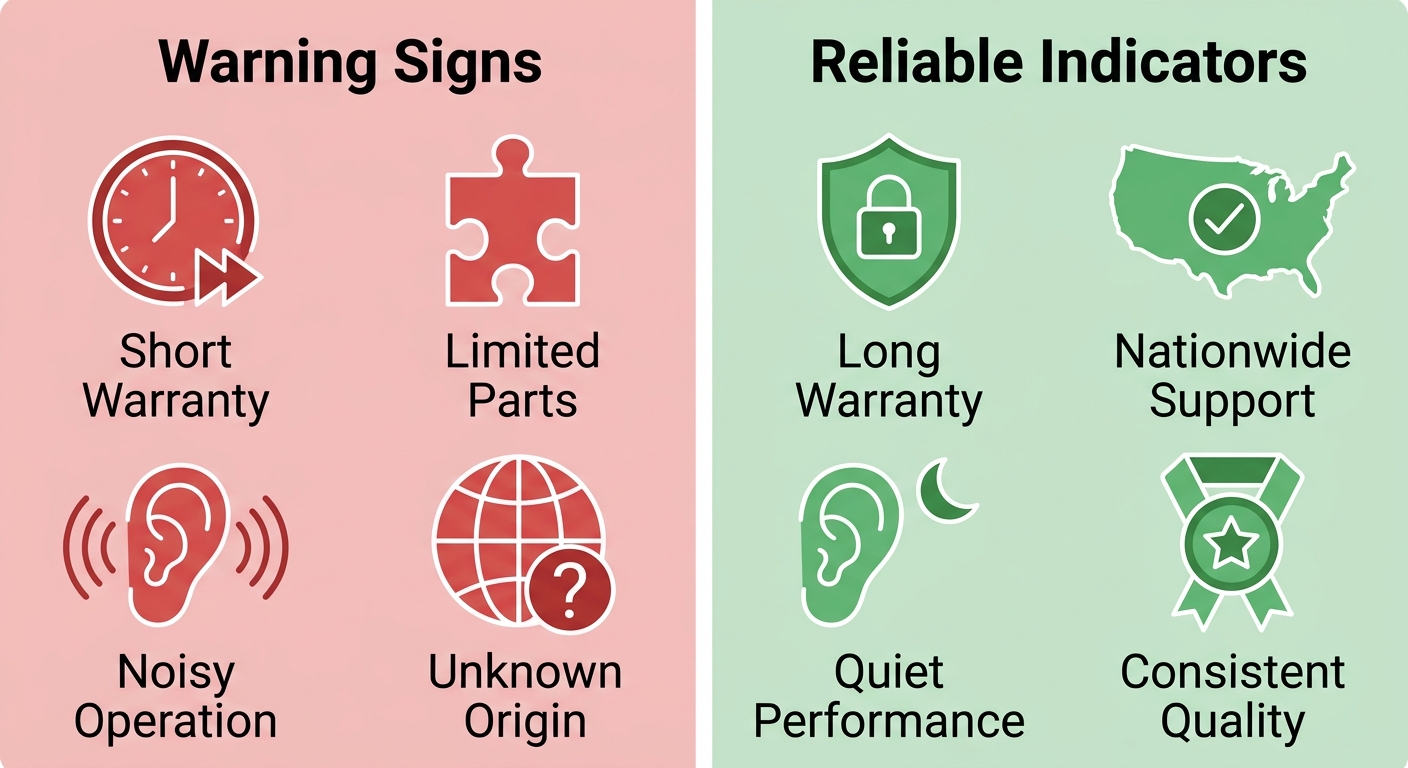
Warning Signs vs. Trust Indicators at a Glance
Use this checklist when evaluating any quote or spec sheet.
| Criteria | Warning Sign (Brands to Avoid) | Reliable Indicator | Example (Avoid/Trust) |
|---|---|---|---|
| Warranty Coverage | Short, unclear warranty that leaves major components under-protected | Long warranty (10+ years) | Check the manufacturer’s written warranty document |
| Parts Availability | Limited regional stock and frequent backorders | Nationwide distributor network | Call a local supply house about lead times |
| SEER Efficiency | Low SEER | High SEER | Compare published efficiency claims against standards |
| Manufacturing Origin | Unknown or inconsistent origin | Consistent country of origin | Review the unit data plate and certifications |
| Noise Levels | Loud operation | Low decibel ratings | Listen to owner recordings and spec sheets |
| Price Range | Extremely low price | Mid-range to premium price | Request itemized quotes to compare scope |
| Customer Support | Hard-to-reach support and slow claims handling | Responsive support team | Contact technical support pre-purchase to test responsiveness |
Each criterion compounds the others: a long-term warranty, available parts, and reachable technical support together protect your investment. With these evaluation methods in hand, you’re ready to move from research to a confident selection — exactly what we’ll cover next.
Making a Confident Choice for Your San Francisco Home
Choosing a mini split system for your San Francisco home becomes straightforward once you understand what mini split brands to stay away from in San Francisco. When you avoid units that have a history of frequent breakdowns or poor customer support, you protect your investment and your peace of mind. By focusing on reliable manufacturers and local installation expertise, you can invest in a system that delivers consistent comfort without unexpected downtime.
The evaluation process you’ve learned—examining warranty coverage, checking installer credentials, and steering clear of brands with widespread reliability complaints—gives you the tools to make a confident purchase. These steps help you bypass the pitfalls that many homeowners encounter when they rush into a decision.
At San Francisco Expert HVAC, we’ve been helping San Francisco families make informed HVAC choices since 1997. Our technicians are available 24/7 for emergency repairs, consultations, and skilled installations. Call us at (415) 371-9413 or visit our office at 1725 Montgomery St, San Francisco, CA 94111 to talk through your options directly. When you combine your research with a trusted local partner who understands this city’s unique needs, your next steps become clear and worry-free.
Make Your Confident Choice
You now understand the key factors that separate reliable mini split brands from those to avoid. With the best practices for evaluating brands fresh in your mind, you’re ready to make a smart purchase for your San Francisco home. For personalized guidance and professional installation, San Francisco Expert HVAC has been serving local homeowners since 1997. Our team is available 24/7 to help with any cooling or heating need, including expert mini split installation. Visit us at 1725 Montgomery St, San Francisco, CA 94111 or call (415) 371-9413 to discuss your options. Let our experience help you choose and install a system that will serve you well for years.