
Table of Contents
- Clean Air Starts at Home: Air Purifier Installation in San Francisco
- The Basics of Air Purifier Installation for Your Home
- HVAC Integration: Choosing the Right Air Purifier System
- Your Air Purifier Installation Journey: What to Expect
- Energy-Smart Air Purifiers: Performance and Efficiency
- Common Questions About Air Purifier Installation Answered
- Take the Next Step: Schedule Your Installation Today
Clean Air Starts at Home: Air Purifier Installation in San Francisco
Clean air starts at home, and air purifier installation in San Francisco is one of the most effective ways to protect your indoor environment. According to the U.S. Environmental Protection Agency, indoor air can be two to five times more polluted than outdoor air, carrying dust, pollen, mold spores, and other contaminants that affect your family’s health.
Proper installation is critical for the unit to work efficiently. Correct sizing, optimal placement, and seamless ductwork integration ensure your air purifier captures pollutants rather than simply recirculating them. In San Francisco, older building infrastructure and often-poor apartment ventilation make professional installation especially important.
Seasonal wildfire smoke adds another layer of risk. A properly installed air purifier can filter fine particulate matter, helping you breathe easier even when outdoor air quality drops. Local HVAC expertise ensures your system is set up to handle these unique challenges while meeting code and safety standards.
Our team handles everything from site assessment to final testing. Installing an air purifier as a whole-home system or a standalone unit, we ensure correct sizing, placement, and connection for optimal performance.
Key benefits include:
- Removal of dust, pollen, and mold spores
- Reduction of wildfire smoke particulates
- Improved airflow with proper duct integration
- Quiet, energy-efficient operation
For expert air purifier setup, contact a reliable HVAC company in San Francisco. Our team at San Francisco Expert HVAC has provided professional air purifier installation since 1997, helping you and your family enjoy cleaner indoor air every day.
The Basics of Air Purifier Installation for Your Home
Air purifier installation can dramatically improve your home’s indoor air quality, but the right approach depends on whether you need single-room treatment or whole-house filtration. Before you decide, it’s wise to consult the EPA indoor air quality guidelines, which explain how proper installation and placement affect a purifier’s effectiveness. Homeowners generally choose among three categories: portable units, whole-home systems integrated into existing ductwork, and HVAC-integrated filters that work inside the air handler. The table below summarizes the key differences among these options, including installation method, ideal use, cost ranges, and maintenance requirements.
| Type | Installation Method | Best For | Cost | Maintenance |
|---|---|---|---|---|
| Portable | Plug-in; no HVAC integration | Single rooms, renters, temporary use | Low to moderate ($100–$800) | Filter changes every 3–6 months |
| Whole-Home | In-duct; integrated with forced-air system | Entire-house coverage, allergy households | Moderate to high ($800–$2,500 installed) | Filter changes every 6–12 months |
| HVAC-Integrated | Media filter, electronic, or UV in air handler | Maximum filtration, low ongoing effort | High ($1,200–$3,500 installed) | Minimal; periodic cleaning or filter swaps |
As the table illustrates, portable air purifiers provide the simplest air purifier setup — just plug them in and place them where filtration is needed most. Whole-home and HVAC-integrated options, on the other hand, demand professional installation because they interface directly with your home’s forced-air system and electrical supply.
Portable air purifiers require no permanent installation. You simply:
- Plug the unit into a standard 120V outlet.
- Position it away from walls and large furniture to maintain unobstructed airflow.
- Replace or clean the internal filter every three to six months.
The U.S. Environmental Protection Agency recommends placing a portable purifier in the room where your family spends the most time, such as the living room or main bedroom, and keeping it a few feet from walls and draperies to maximize particle capture.
Whole-home air purifiers are installed directly into your ductwork:
- The unit is mounted in the main supply or return duct, often requiring a dedicated electrical circuit.
- A licensed technician cuts into the duct, mounts the purifier housing, and seals all connections to prevent air leaks.
- The control module integrates with your thermostat so the purifier runs whenever the HVAC fan operates.
HVAC-integrated filters such as high-efficiency media filters and electronic air cleaners sit inside the air handler cabinet:
- The original 1-inch filter slot is replaced with a deeper filter frame that holds a thicker, high-MERV media.
- Installation often involves modifying the air handler door or adding a transition to ensure a tight seal.
- Electronic models may require a dedicated power supply and periodic plate cleaning.
No matter which system you consider, installing an air purifier correctly is crucial for both performance and energy efficiency. The U.S. Department of Energy sets HVAC efficiency standards that can be affected if an air purifier restricts airflow or forces the blower to work harder. Proper sizing and professional calibration prevent unnecessary strain on your equipment.
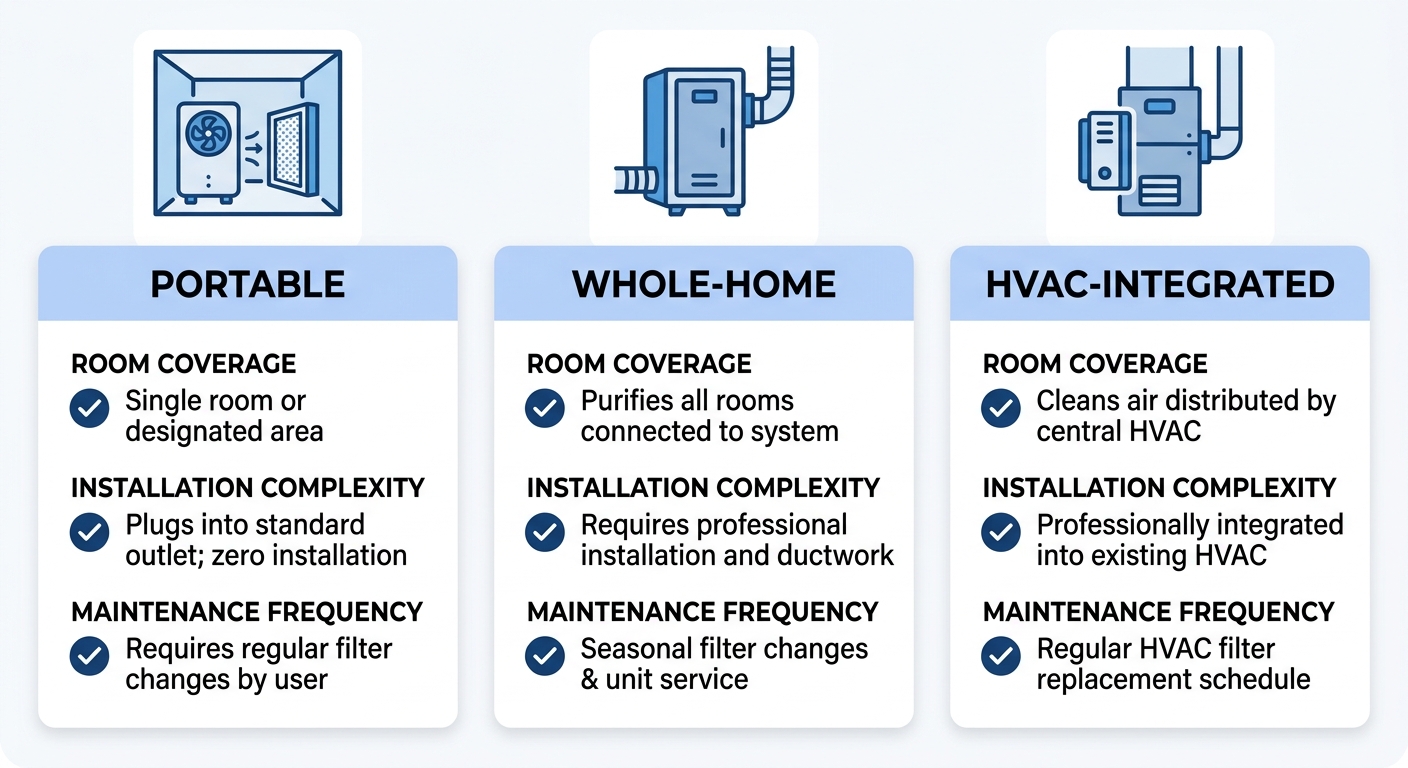
Comparison of three air purification installation approaches for residential HVAC systems.
Local building codes and climate conditions also play a role in air purifier installation. For example, in San Francisco, homes with older duct systems may require additional sealing or electrical upgrades to meet California’s energy efficiency standards. Always verify that any whole-home or HVAC-integrated unit is compatible with your existing equipment and installed by a qualified professional.
Once you understand the basics of each installation method, you can weigh the trade-offs between upfront cost, long-term maintenance, and whole-house coverage. The next section will walk through the detailed steps for each type and help you decide whether a do-it-yourself approach or professional service is right for your situation.
HVAC Integration: Choosing the Right Air Purifier System
Selecting an air purifier installation for your San Francisco home involves more than just picking a device off the shelf. A whole-home HVAC-integrated air purifier system treats the air circulating through your entire ductwork, capturing contaminants that portable units often miss. Understanding the differences between available technologies, the scope of necessary modifications, and how the system will interact with your existing smart home setup ensures you make a decision that delivers cleaner air and long-term value.
The following table compares the three primary types of HVAC-integrated purifiers to help you evaluate which approach suits your household’s needs and your home’s infrastructure.
| Type | Effectiveness | Installation Complexity | Ductwork Changes | Cost Range |
|---|---|---|---|---|
| Media Filter | MERV 13–16; removes particles, allergens | Simple; slots into existing filter housing | Minimal; may need filter cabinet adjustment | $400–$1,000 |
| Electronic Air Cleaner | High; electrostatic charge captures fine particles | Moderate; requires dedicated power and mounting | Minor; may need access panel and wiring | $800–$2,200 |
| UV Germicidal Lamp | Microbial reduction; does not remove particles | Low to moderate; installs near evaporator coil | Minimal; mount inside existing ductwork | $300–$800 |
Types of HVAC-Integrated Air Purifiers
When you explore options for a whole-home air purifier system, you will encounter three main technologies, each operating on different principles to improve indoor air quality. Media filters use densely pleated material to trap airborne particles as air passes through. According to the U.S. Environmental Protection Agency (EPA), filters rated MERV 13 through 16 capture a high percentage of common allergens, dust, and mold spores, making them a reliable choice for allergy sufferers. These systems are the simplest to install, typically sliding into the existing filter housing with only minor cabinet adjustments needed.
Electronic air cleaners take a different approach by applying an electrostatic charge to particles, which then adhere to collector plates inside the unit. This technology excels at capturing extremely fine particulate matter that might slip through a standard media filter. The U.S. Department of Energy (DOE) energy efficiency benchmarks—updated regularly under DOE HVAC energy standards—help homeowners compare the operational energy consumption of electronic models against other filtration methods, ensuring you understand both performance and long-term utility costs.
UV germicidal lamps serve a specialized role by targeting biological contaminants like bacteria, viruses, and mold spores rather than physical particles. Installed near the evaporator coil where moisture can encourage microbial growth, these lamps disrupt the DNA of microorganisms to prevent them from reproducing. Because UV systems do not filter dust or allergens, they are often paired with a media filter to deliver comprehensive air treatment. The California Energy Commission’s Title 24 requirements apply to certain electronically powered HVAC accessories, so a San Francisco professional must verify that your selected UV or electronic system complies with state efficiency regulations.
Ductwork Modifications and Retrofit Options
A common concern for San Francisco homeowners is whether adding an HVAC-integrated purifier will require major ductwork surgery. In most cases, the answer is no. Media filters and UV lamps typically require only minimal adjustments, such as enlarging a filter cabinet or cutting a small mounting port near the evaporator coil. Electronic air cleaners may need a dedicated electrical connection and a reinforced access panel, but this work is considered minor and rarely involves reconfiguring your entire duct layout.
San Francisco’s housing stock includes many older Victorian and mid-century homes, and professional installers understand how to work within existing spaces to minimize disruption during an air purifier installation. They assess your ductboard or sheet metal construction, identify the optimal insertion point, and complete the modifications with sealing and insulation that preserve your system’s thermal efficiency. By following California Energy Commission guidelines for HVAC alterations, they ensure that even small changes do not compromise your home’s overall energy performance.
Compatibility with Smart Home Systems
Modern HVAC-integrated air purifiers can integrate with the smart thermostats and home automation platforms that many San Francisco residents already use to manage comfort and energy consumption. When your purifier connects to a smart thermostat, you gain the ability to monitor filter status, track air quality trends, and program the fan to circulate air during high-pollen periods or wildfire smoke events. This coordination helps optimize both filtration effectiveness and energy use, since the system can run the circulating fan only when purification is actually needed.
The key to seamless integration lies in selecting equipment that communicates via compatible protocols, which your installer can verify during the planning phase. By connecting your whole-home air purifier system to the broader smart ecosystem, you turn air quality management into a set-it-and-forget-it function rather than a series of manual adjustments. This integrated approach delivers cleaner air throughout your San Francisco home without adding complexity to your daily routine.
Your Air Purifier Installation Journey: What to Expect
When you are ready to improve your home’s indoor air quality, understanding the air purifier installation process helps set clear expectations. A whole-home air purification project typically moves through three distinct phases: on-site assessment, professional installation, and post-installation testing. Our team at San Francisco Expert HVAC can walk you through each step so you know exactly what to anticipate when a purifier system installation is scheduled in San Francisco.
Step 1: On-Site Assessment and Equipment Selection
A qualified technician begins with a thorough walkthrough of your property. Media filter, electronic air cleaner, and UV germicidal lamp systems each serve different needs, so the evaluation focuses on your home’s layout, existing ductwork, and any health concerns you mention. A licensed professional who understands residential HVAC in San Francisco can measure room volumes, inspect your furnace or air handler, and explain how a purifier would integrate with your current setup. This tailored assessment helps you choose the equipment that will deliver the best balance of particle capture, microbial control, and long-term value.
Because every home is unique, the technician will also listen to your top priorities—whether that is reducing wildfire smoke particles, managing seasonal allergens, or controlling airborne germs. By matching your needs with the right technology, you avoid overspending on features you will never use and gain confidence that the recommended solution fits your San Francisco residence.
Professional Installation Procedures
Once the equipment is selected, the installation team schedules a dedicated appointment and arrives with all necessary hardware. The actual purifier system installation typically involves either integrating the device into your existing ductwork or mounting a standalone unit with appropriate electrical connections. For a whole-home air purifier setup, the technician cuts into the return or supply plenum, secures the purifier cabinet, and hardwires it to a dedicated circuit. Every mounting point is reinforced to prevent vibration and noise, and all connections are sealed to maintain airflow efficiency.
Throughout the work, our crew protects your floors and furnishings with drop cloths and cleans the work area at the end of the day. Because San Francisco building codes can influence any modification to a forced-air system, having a knowledgeable professional manage the project ensures compliance and safety.
To help you compare upfront investment and ongoing costs, San Francisco Expert HVAC has pulled together the following ranges from its own local project data. The table below reflects typical pricing for equipment and routine consumables in the Bay Area.
| System Type | Installation Cost | Annual Filter Cost | Efficiency Improvement |
|---|---|---|---|
| Media Filter (MERV 16) | $400–$1,000 | $100–$300 | Up to 95% particle removal |
| Electronic Air Cleaner | $800–$2,200 | $50–$150 (washable cells) | Up to 98% particle removal |
| UV Germicidal Lamp | $300–$800 | $20–$60 (lamp replacement) | Reduces microbial growth; no particle removal |
Post-Installation Testing and Maintenance
After the system is mounted and powered, the technician performs a series of tests to confirm proper operation. Airflow is checked at multiple registers, and the pressure drop across the purifier is measured to ensure it does not restrict your HVAC system. If your equipment includes a UV lamp or electronic cell, electrical draw and indicator lights are verified. In many cases, an air quality monitor is placed temporarily to log particle counts, giving you concrete proof that the unit is performing as designed.
Ongoing upkeep is straightforward. Media filters generally need replacement every 6 to 12 months, depending on household dust levels and outdoor air quality. Electronic cells should be removed and cleaned quarterly to maintain their high efficiency, while UV lamps lose intensity over time and should be replaced annually. Sticking to these schedules preserves the system’s performance and helps avoid costly repairs down the road. For specific maintenance guidance tailored to your setup, our team at San Francisco Expert HVAC is always available to answer questions and help you keep your indoor air fresh and clean.
Energy-Smart Air Purifiers: Performance and Efficiency
When you evaluate air purifiers as a home comfort upgrade, not all models deliver the same efficiency. Energy-smart air purifiers combine high-performance filtration with optimized energy use, helping you maintain clean indoor air without driving up your utility bill in San Francisco.
In many energy-smart designs, efficient DC motors and smart sensors continuously monitor air quality. The sensors automatically adjust fan speed when airborne particles decrease, so the machine doesn’t run at full power around the clock. You also benefit from programmable timers and sleep modes that further reduce electricity consumption.
Performance is measured by Clean Air Delivery Rate (CADR) and energy consumption. CADR tells you how quickly a purifier removes smoke, dust, and pollen from a room (rated in cubic feet per minute), while energy consumption (watts) reflects its electrical demand. The U.S. Department of Energy sets minimum efficiency benchmarks so that even entry-level models meet a basic standard.
Here’s a quick summary of the metrics that matter most:
- CADR: The volume of clean air a purifier delivers per minute; higher ratings mean faster purification.
- Energy consumption: Measured in watts; lower wattage equals lower long-term electricity costs.
- Energy efficiency rating: A scale indicating how many cubic feet of air are cleaned per watt consumed.
In San Francisco, state-level regulations push efficiency even further. The California Energy Commission HVAC enforces Title 20 and Title 24 standards that set minimum energy performance requirements for portable air cleaners. These rules are part of California’s appliance efficiency program, which has saved residents an estimated $5 billion in energy costs.
When a purifier adjusts its motor speed based on real-time air quality rather than blasting at full capacity, you save money on monthly electricity bills. Over time, that lower wattage can add up to noticeable savings while still trapping allergens, pollen, and wildfire smoke.
By choosing an energy-smart design that meets both federal and California-specific standards, you gain steady indoor air quality without inefficient energy waste. In the next section, we’ll look at how professional installation ensures your new system performs exactly as rated.
Common Questions About Air Purifier Installation Answered
If you’re considering air purifier installation in San Francisco, you likely have a few questions before moving forward. Below, we answer the most common concerns so you can make an informed decision.
Do I need a professional to install an air purifier?
Yes, a licensed HVAC technician is strongly recommended for whole-house units. Proper integration with your heating and cooling ducts and electrical connections requires specialized knowledge. San Francisco Expert HVAC brings over 20 years of residential service experience to every job, ensuring safe and code-compliant installations.
How much does air purifier installation cost?
Costs vary widely based on the purifier type and your home’s existing setup. According to San Francisco Expert HVAC’s FAQ, a complete HVAC replacement in the area runs from about $8,500 to $18,000, but integrating an air purifier is usually much less—often just a few hundred dollars for the hardware and labor. A professional estimate gives you the most accurate number.
How long does air purifier installation take?
Most installations are completed in one to three hours. The process involves mounting the unit, sealing connections, and testing airflow. A skilled technician works efficiently to minimize any disruption to your home.
Can I install an air purifier myself?
DIY installation is feasible for portable, plug-in models that don’t require duct modifications. Whole-house systems, however, demand expertise in electrical wiring and airflow balancing—work that is best left to a professional to avoid performance issues or safety hazards.
Will an air purifier work with my existing HVAC system?
In nearly all cases, yes. Today’s purifiers are designed for standard residential systems. If your furnace needs attention, a pre-installation tune-up or furnace repair ensures everything operates smoothly. A quick system assessment can confirm compatibility before you commit.
To discuss your options and get a personalized quote for your San Francisco home, call San Francisco Expert HVAC at (415) 371-9413 or reach out through our website.
Take the Next Step: Schedule Your Installation Today
Now is the perfect moment to schedule installation for your home in San Francisco. We offer expert furnace, air conditioning, and thermostat installation backed by decades of local experience. Your comfort is our priority.
- Furnace Installation
- Air Conditioning Installation
- Thermostat Installation & Repair
We provide free estimates and same-day availability. Book your appointment now by calling (415) 371-9413 or reserving online. We proudly serve all San Francisco neighborhoods and surrounding communities. Contact us today for reliable installation you can count on.
Click Schedule Now to get started. Your comfortable home is just around the corner.