
Table of Contents
Understanding R-454B Refrigerant Systems
R-454B refrigerant systems represent the next generation of air conditioning technology designed to replace R-410A with a significantly lower environmental footprint. With a global warming potential (GWP) of approximately 466, compared to R-410A’s 2,088, R-454B refrigerant offers a more sustainable path for residential cooling. Classified as A2L, a mildly flammable designation, this refrigerant requires proper handling by certified professionals, but its safety profile is well understood under current standards. The EPA’s AIM Act mandates a phasedown of high-GWP refrigerants, making R-454B a compliant choice that aligns with federal regulations. In San Francisco, where environmental stewardship is a priority, upgrading to an R-454B-based system can reduce home emissions. San Francisco Expert HVAC provides installation and maintenance for these advanced systems, and for expert care, homeowners can rely on HVAC services in San Francisco.
1. What Is R-454B and Why It Matters
R-454B is a next-generation hydrofluoroolefin (HFO) refrigerant blend designed to replace R-410A in residential air conditioning systems. With a global warming potential (GWP) of about 466—significantly lower than R-410A’s GWP of 2,088—it helps reduce environmental impact. If you are researching r-454b refrigerant systems, understanding this shift is key to preparing your San Francisco home for upcoming changes.
The transition is driven by the U.S. Environmental Protection Agency (EPA) and the American Innovation and Manufacturing (AIM) Act, which phases down high-GWP refrigerants. Because R-454B is mildly flammable (classified as A2L), its installation and service require technicians with specialized training. As more manufacturers adopt r-454b refrigerant systems, planning ahead for the transition makes sense. For homeowners in San Francisco, choosing a company experienced with the latest refrigerant standards is crucial when you need HVAC repair in San Francisco. Our team at San Francisco Expert HVAC is ready to handle new R-454B systems and ensure safe, reliable service.
San Francisco’s moderate summers make efficiency and environmental benefits especially valuable, making early adoption a smart choice. While existing R-410A systems remain safe, planning now for an eventual upgrade can help you stay ahead of regulations. Understanding R-454B is the first step in preparing your home for the future of cooling.
2. Industry Shift to R-454B in 2026
The transition to r-454b refrigerant systems in 2026 will fundamentally reshape residential air conditioning. As of that year, all new HVAC equipment must use low-GWP refrigerants like R-454B, replacing R-410A.
The U.S. Environmental Protection Agency’s SNAP program and the American Innovation and Manufacturing (AIM) Act of 2020 are driving this change. According to the latest EPA HVAC refrigerant guidelines, the phase-down of high-GWP HFCs requires R-454B—a blend of R-32 and R-1234yf with a GWP around 466, about 75% lower than R-410A. The Air-Conditioning, Heating, and Refrigeration Institute (AHRI) certifies r-454b refrigerant systems for safety and performance, ensuring they meet industry standards. Major manufacturers are retooling production lines to meet the 2026 compliance deadline.
Existing R-410A units will remain serviceable with reclaimed refrigerant, but new installations in San Francisco will require equipment designed for R-454B. Homeowners in San Francisco planning upgrades should anticipate the availability of r-454b refrigerant systems from local HVAC providers.
3. R-454B vs. R-32: Side-by-Side
For San Francisco homeowners evaluating R-454B refrigerant systems, understanding how they compare to R-32 is essential. To make an informed choice, here is a direct comparison based on AHRI HVAC certification data. Both refrigerants carry an A2L mildly flammable safety classification. The table below highlights their key differences.
| Feature | R-454B | R-32 |
|---|---|---|
| GWP Rating | ~466 | ~675 |
| Safety Class | A2L (Mildly Flammable) | A2L (Mildly Flammable) |
| Performance Efficiency | High (Optimized for new units) | High (Proven globally) |
In San Francisco’s moderate climate, both refrigerants deliver reliable cooling and heating performance and comply with EPA SNAP and CARB regulations. R-32 units are more widely stocked today, while R-454B refrigerant systems are increasingly common as manufacturers introduce new models optimized for efficiency and low-GWP operation. For retrofits, R-32 is often the more practical choice; R-454B systems generally require new equipment.
4. Retrofitting Older Units for R-454B
Even though R-454B offers clear advantages, many San Francisco homeowners wonder if they can keep their existing unit. Existing r-454b refrigerant systems are designed for this specific blend and cannot simply accept the new refrigerant in older equipment. The U.S. Environmental Protection Agency mandates that only EPA-listed refrigerants be used in approved systems, and professional retrofitting is required to maintain compliance. R-22 units are rarely viable candidates for conversion — the necessary changes are so extensive that the EPA effectively prohibits the practice — while R-410A systems are more adaptable but still demand major modifications.
A successful R-454B retrofitting project requires replacing the expansion valve, compressor, and often the condenser coil. These aren’t minor adjustments; they represent a significant overhaul of the system’s core components. Because labor accounts for 40 to 55 percent of most replacement costs in the San Francisco area, according to local pricing data from San Francisco Expert HVAC, a partial retrofit can quickly approach the price of a new unit. In San Francisco’s mild climate, where heating and cooling loads are moderate, the efficiency gains from a retrofit are real but may take longer to offset the upfront expense.
Full replacement generally delivers better long-term value and reliability, especially for systems over 15 years old, and high-efficiency configurations can cut annual utility bills by $400 to $650. This type of overhaul also presents an excellent opportunity to improve indoor air quality with professional air purifier installation. For a detailed breakdown of expenses, see our HVAC replacement cost page.
5. Safety Requirements for R-454B
Given these properties, safety requirements for R-454B refrigerant systems are critical due to the refrigerant’s A2L classification. Specific protocols safeguard technicians and building occupants against mild flammability risks.
- R-454B is classified as A2L (mildly flammable) by ASHRAE, and EPA regulations require careful handling to reduce ignition risk.
- Leak detectors must be certified for A2L refrigerants and set to appropriate alarm thresholds; EPA guidelines outline minimum detection levels.
- Mechanical ventilation is necessary when servicing indoor R-454B systems to prevent refrigerant accumulation near open flames or sparks.
- Technicians should wear personal protective equipment including safety glasses, gloves, and flame-resistant clothing where ignition sources are present.
- Per AHRI standards, equipment designed for R-454B must pass AHRI Standard 700 purity verification to verify compatibility and safe operation.
Compliance with EPA and AHRI requirements is not just a legal obligation—it is essential for workplace safety and reliable system performance. With these protocols in place, proper installation ensures long-term reliability.
6. Maintenance Costs: Myth vs. Reality
While HVAC maintenance costs are often misunderstood, separating myth from reality can save San Francisco homeowners significant money over time.
Myth: Annual HVAC maintenance costs hundreds of dollars.
Reality: In San Francisco, service plans from local experts like San Francisco Expert HVAC typically range from $150 to $300 — a fraction of the cost of a major repair.
Myth: If the system is running fine, maintenance is unnecessary.
Reality: Small issues caught early prevent costly breakdowns. Neglecting routine care often leads to premature replacement; a full system in San Francisco costs $8,500 to $18,000 according to our own replacement data. Regular maintenance avoids that five-figure bill. Plus, heat pump rebates through programs like TECH Clean California can lower your total cost of ownership, making annual tune-ups even smarter.
A similar misconception surrounds r-454b refrigerant systems — many assume they are more expensive to maintain, but their service requirements are comparable to older units. Understanding the real costs turns maintenance from a perceived expense into a reliable investment in your home’s comfort and efficiency.
7. Efficiency Gains That Save You Money
Upgrading to r-454b refrigerant systems represents one of the most impactful financial moves you can make for your San Francisco home. These modern units deliver tangible month-over-month savings that compound over the life of the equipment.
The efficiency advantage comes from improved heat transfer capabilities and variable-speed compressor technology that reduces electricity consumption compared to older R-410A models. For San Francisco homeowners, this means the system works less to maintain consistent indoor comfort, particularly during our mild coastal winters. Less runtime directly translates to lower monthly utility bills without sacrificing performance.
Beyond the immediate energy savings, high-efficiency systems experience reduced wear on critical components. Fewer repair calls and a longer functional lifespan mean you avoid the costly cycle of frequent service visits that plague aging equipment. When you pair these operational savings with the available 2026 rebates detailed in our incentive guide, the payback period shortens considerably, making this upgrade a sound financial decision for years to come.
8. Preparing Your Home for R-454B
Preparing your San Francisco home for R-454B refrigerant systems requires attention to safety and compatibility. Since R-454B is classified as an A2L “mildly flammable” refrigerant, you must ensure the installation area has adequate ventilation and no nearby ignition sources. You will also need a certified technician to inspect the existing indoor coil and line set—older components designed for R-22 or R-410A often need replacement to work with these new refrigerant systems.
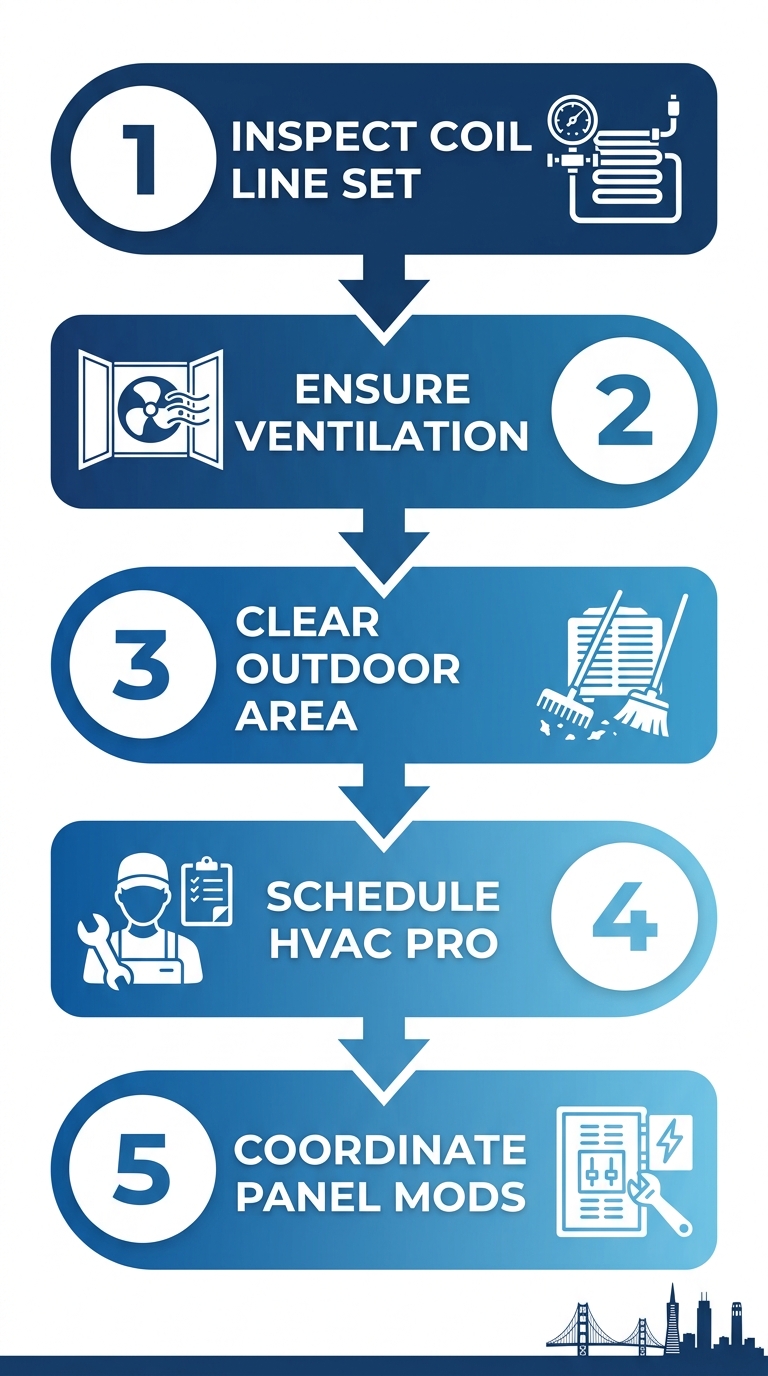
Five-step preparation guide for R-454B HVAC installation.
In addition, clear the area around the outdoor unit to comply with local San Francisco setback codes and provide enough clearance for airflow and service access. All installation work must be performed by EPA-certified professionals—DIY attempts are unsafe and illegal for these refrigerants. At San Francisco Expert HVAC, our experienced technicians handle every preparation step, and we can coordinate any necessary modifications to your electrical panel or ductwork during your installation appointment. Contact us today to schedule your R-454B installation and ensure your home is ready for the new refrigerant standard.
Making the Smart Switch to R-454B
For San Francisco homeowners, upgrading to r-454b refrigerant systems is a forward-thinking choice that aligns with California’s environmental goals. R-454B has a significantly lower global warming potential than R-410A, directly supporting the state’s refrigerant regulations. This change helps future-proof homes against tightening state limits, supports local climate targets, preserves system performance, and meaningfully reduces long-term environmental risk for homeowners. Systems bearing AHRI certification have been rigorously tested for performance and efficiency, so you can invest with confidence. San Francisco Expert HVAC is equipped to handle conversions and new installations, and making the switch to r-454b refrigerant systems is straightforward when you work with a knowledgeable local team.