
Table of Contents
- Signs Your HVAC Needs Repair: What San Francisco Homeowners Should Know
- Loud Banging or Squealing Noises from Your HVAC System
- Weak Airflow and AC Blowing Warm Air
- HVAC Short Cycling: When Your System Turns On and Off Too Often
- A Sudden Spike in Your Energy Bill
- Musty or Burning Smells from Your HVAC Vents
- Take Action to Protect Your HVAC System
Signs Your HVAC Needs Repair: What San Francisco Homeowners Should Know
Recognizing the early signs hvac needs repair can prevent a minor issue from becoming a major system failure. Drawing on our decades of experience serving the city since 1997, San Francisco Expert HVAC recommends watching for these four indicators.
- AC Blowing Warm Air: If your ac blowing warm air, the culprit could be a refrigerant leak or a failing compressor, which requires a professional diagnosis to address correctly.
- HVAC Short Cycling: When your system exhibits hvac short cycling, turning on and off rapidly, it is often a sign of an overheating unit, a clogged filter, or a more complex electrical fault that puts undue stress on components.
- Unusual Noises: Banging or squealing sounds coming from the unit are never normal and can point to a loose belt, a broken motor bearing, or a failing part that will worsen without prompt attention.
- Higher Energy Bills: A sudden spike in your monthly energy costs, without a corresponding increase in usage, frequently means your system is struggling to operate efficiently due to an underlying mechanical problem.
The unique challenges of San Francisco’s older building stock and coastal air can accelerate these issues. If you notice any of these symptoms, a trusted HVAC company in San Francisco can provide a thorough inspection and reliable repair to restore your comfort.
Loud Banging or Squealing Noises from Your HVAC System
When your heating or cooling system begins producing loud banging or squealing sounds, these are clear signs HVAC needs repair. Unusual noises are never normal and almost always indicate a mechanical problem that will worsen without professional attention. In San Francisco’s older homes, where HVAC equipment and ductwork may have decades of wear, these sounds demand immediate action.
Banging noises often point to loose or broken components inside the system. A loud bang could be caused by an unbalanced blower wheel, a loose connecting rod, or debris trapped in the indoor unit. In furnace systems, ductwork expansion and contraction can also produce banging sounds as metal warms and cools. While some of these issues may seem minor at first, continued operation can lead to severe damage. For example, vibration from a loose part can stress the heat exchanger, potentially causing cracks that create carbon monoxide leaks—a serious safety hazard for any household. The Bay Area’s microclimates put added strain on HVAC equipment, and ignoring these warning sounds only increases the risk of a complete breakdown or fire from electrical shorts caused by persistent shaking.
Squealing noises are typically related to moving parts that require lubrication or replacement. A high-pitched squeal often comes from a worn blower belt slipping on the pulley, a failing motor bearing, or a fan motor that has lost its lubrication. These components run continuously when the system is active, so even minor wear can create a sharp noise that grows louder over time. In older San Francisco homes, aging belt-driven blowers are particularly prone to this issue. Letting a squealing sound persist can allow the belt to break entirely, leaving the system unable to move air. Worse, a seized motor bearing can cause the blower motor to overheat and fail, turning a simple repair into a full motor replacement. Other related symptoms you may notice include your AC blowing warm air or hvac short cycling, both of which often accompany mechanical trouble signaled by noise.
Don’t ignore these signs your HVAC needs repair—taking swift action protects your home and your family’s safety. Before the problem escalates, shut the system down and contact a qualified HVAC company in San Francisco like San Francisco Expert HVAC. With over 20 years of experience serving local homes, our team diagnoses and repairs furnace and air conditioning issues quickly, and we offer comprehensive maintenance to stop noises before they start. Call us today to schedule an inspection and keep your system running quietly and safely.
Weak Airflow and AC Blowing Warm Air
Beyond strange sounds, weak airflow and warm air are clear signals your HVAC needs attention. In fact, these are classic signs hvac needs repair that shouldn’t be ignored. Understanding the possible causes helps you decide whether a DIY check or professional service is the right call.
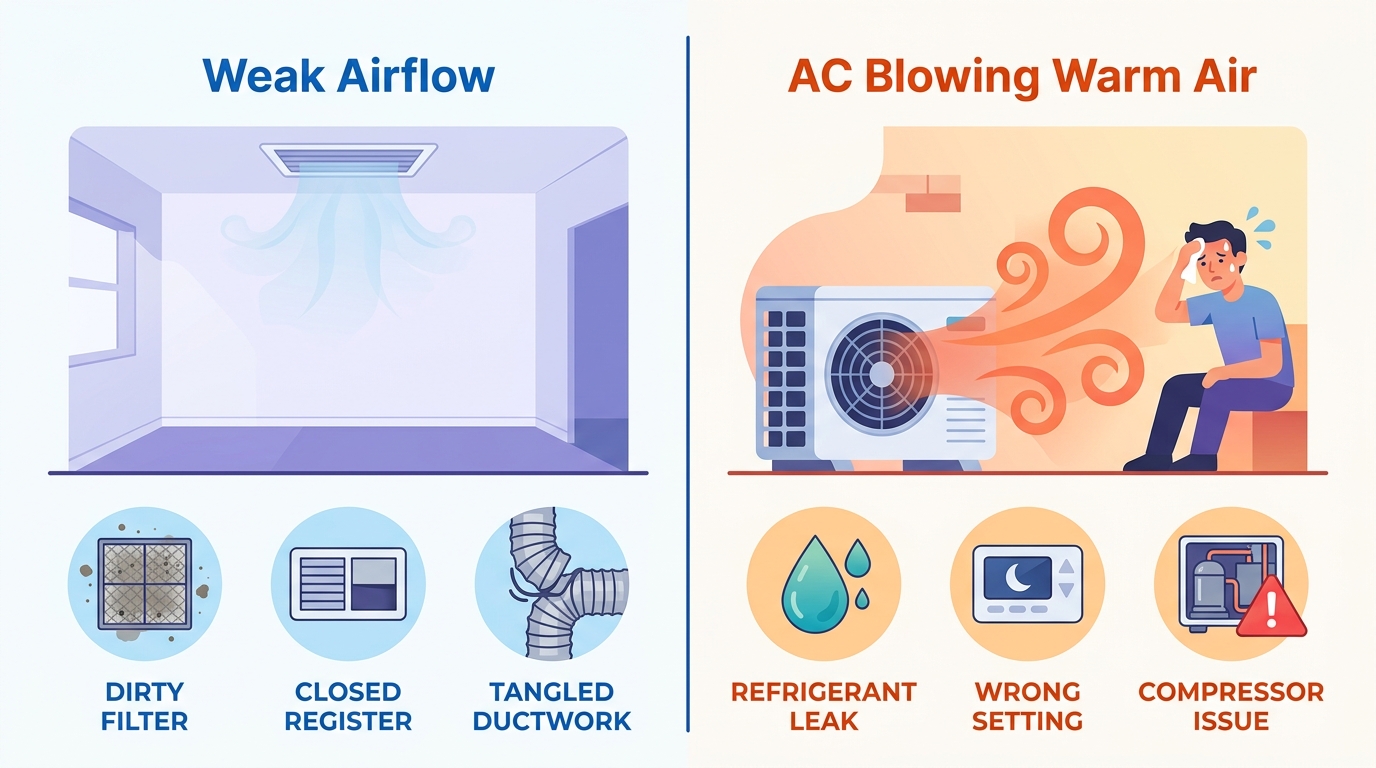
Side-by-side comparison of weak airflow and warm AC causes.
Weak airflow often starts with something as simple as a clogged air filter. Check yours monthly and replace it every 1–3 months to keep air moving freely. Next, walk through your home and make sure all supply vents are open and not blocked by furniture or curtains—closed registers force the system to work harder and reduce comfort throughout the house. In older San Francisco homes, ductwork leaks or poor design can also contribute to weak airflow. Additionally, hvac short cycling—where the system turns on and off rapidly—can result from an oversized unit or dirty coils, cutting into both airflow and cooling performance.
If your AC is blowing warm air, the leading cause is a refrigerant leak, often accompanied by hissing sounds or ice on the indoor coil. Simply adding more refrigerant is not a permanent fix; the leak must be located and repaired by an EPA-certified technician. A failing compressor or a faulty reversing valve in heat-pump systems can also lead to warm air and requires professional service. Before calling for help, double-check that your thermostat is set to cool mode at the desired temperature and that the circuit breaker hasn’t tripped—these easy steps can save you an unnecessary service call.
When basic troubleshooting doesn’t solve the problem, it’s time to bring in a professional. Our team at San Francisco Express HVAC sees these issues daily and can pinpoint the root cause quickly. If your system is more than 10 years old or repairs are adding up, reviewing the HVAC replacement cost guide can help you plan ahead and weigh the benefits of a new, high-efficiency unit.
HVAC Short Cycling: When Your System Turns On and Off Too Often
Beyond broad warning signs, homeowners often notice a specific behavior: hvac short cycling. This term describes an HVAC system that repeatedly turns on and off in rapid succession, completing a full heating or cooling cycle in under ten minutes, or cycling more than several times per hour. If your furnace runs for just five minutes then shuts off, that is short cycling, and it is one of the most telling signs hvac needs repair.
The problem is both immediate and cumulative. A short cycling system wastes significant energy, often increasing monthly utility bills by 15 to 30 percent. If your system short cycles, you may notice a sudden spike in your utility bills – a classic HVAC failure energy bill sign that should not be ignored. Beyond the financial cost, the constant starting and stopping places extreme stress on the compressor, fan motors, and electrical components, dramatically shortening the lifespan of the equipment. Comfort also suffers, as rooms never reach a stable temperature, creating persistent hot and cold spots throughout the home.
Several common causes trigger this rapid on-off cycling, especially in the San Francisco Bay Area’s moderate climate. The most frequent culprit is an oversized air conditioner or furnace. When a system is too powerful for the home, it satisfies the thermostat setting too quickly and shuts down before completing a proper dehumidification or heating cycle. During San Francisco’s mild summers, this is an especially common scenario with oversized AC units. Other causes include a thermostat placed near a heat source or in direct sunlight, which tricks the sensor into thinking the home is warmer than it actually is, triggering an early shutdown. Dirty air filters restrict airflow, causing the system to overheat and trip its safety limit switch, while a refrigerant leak can cause the compressor to cycle erratically. Even ductwork restrictions, such as crushed or undersized return ducts, can starve the system of air and provoke frequent cycling.
Homeowners should also recognize that short cycling produces distinct symptoms. During a short-cycling episode, the AC may blow warm air because it never completes a full cooling cycle, failing to remove humidity and deliver consistent chilled air. The blower may run for a few minutes, stop, and restart repeatedly. These patterns are not normal and indicate an underlying mechanical or design issue that requires professional attention. While checking and replacing a visibly dirty air filter is a sensible first step, true diagnosis demands specialized tools and training.
Understanding short cycling is the first step toward restoring reliable, efficient comfort. A professional inspection can identify whether the cause is an oversized system, a faulty thermostat location, low refrigerant charge, or blocked ductwork, and then recommend the correct repair. The next section explores how a faulty thermostat can cause this exact problem and what a professional solution entails.
A Sudden Spike in Your Energy Bill
You’re sorting through the mail on a damp San Francisco morning when you open your utility statement—and your heart sinks. The balance is 25% higher than last month, even though you haven’t used your heating or cooling any differently. That unexpected jolt is more than just a budgeting headache; one of the clearest signs HVAC needs repair is a sudden jump in your energy bill without a matching change in your usage habits.
When an air conditioner or furnace starts losing efficiency, the system has to work longer and harder to deliver the same amount of comfort. According to the U.S. Department of Energy, dirty filters, leaking ducts, and poorly maintained equipment are among the most common causes of energy waste in American homes. In San Francisco’s foggy coastal air, those filters tend to clog faster than average, trapping airborne moisture and microscopic particles. Over time, a heavily obstructed filter forces the blower motor to strain against the resistance, consuming significantly more electricity or gas while steadily raising your monthly bill.
Clogged filters are only one piece of the puzzle. A slow refrigerant leak, for instance, forces the compressor into excessive runtimes even on moderate Bay Area afternoons; you might also notice the AC blowing warm air from the registers despite the thermostat calling for cool air. Similarly, a failing compressor or fan motor draws far more current as it struggles to maintain speed, and small duct leaks in a fog-cooled crawlspace can dump conditioned air outside the living area. Any of these mechanical issues can combine with a misbehaving thermostat that cycles the equipment too frequently. Such HVAC short cycling further drags down efficiency—starting and stopping uses more energy than steady operation—and accelerates wear on expensive components.
Pay attention to persistent vent smells, too. A damp, mold-saturated filter or duct liner won’t just spike your bill; it can create a musty odor that signals a deeper indoor-air-quality problem. This is a common HVAC vent odor problem sign when coastal moisture gets trapped inside the ductwork, nourishing mold and bacteria that force the air handler to push harder against restricted airflow.
Before you panic, try a quick comparison: check the actual kilowatt-hour or therm usage on your bill, not just the dollar total, to rule out a rate increase. Then swap the air filter and listen for unusual sounds such as clanking or short cycling. Ignoring the spike can allow a worn compressor or a cracked heat exchanger to progress to the point where a manageable repair becomes an emergency replacement. If the numbers still don’t add up, contact San Francisco Expert HVAC for a professional inspection—our technicians will identify the source of the waste before it gets any worse.
Beyond the bill, two related problems often appear: your AC blowing warm air or the system short cycling. Understanding these symptoms in tandem will help you protect your comfort and your budget all year long.
Musty or Burning Smells from Your HVAC Vents
Beyond unusual noises or short cycling, one of the clearest signs HVAC needs repair is an unusual smell coming from your vents. In San Francisco’s fog-prone climate, recognizing these warning odors early can prevent costly damage and protect your home’s comfort.
A sharp, electrical burning smell is often compared to hot wires or melting plastic. According to the Environmental Protection Agency, a brief dusty odor when you first turn on the heat is normal as accumulated particles burn off. However, a persistent burning odor that smells like overheating electronics indicates a serious issue — such as a seized blower motor, failing capacitor, or melting wire insulation. If you smell this, shut off your HVAC system immediately and call a licensed technician. Ignoring an electrical burning odor can pose a fire risk. San Francisco Expert HVAC responds to emergency calls 24/7 at (415) 371-9413 and will diagnose the problem safely.
A musty smell, like damp basement or wet socks, is another common complaint. This odor typically points to mold or mildew growth inside your ductwork, drain pan, or evaporator coil — especially in San Francisco’s cool, foggy climate where moisture accumulates easily. The EPA warns that indoor mold can trigger allergies, asthma, and other respiratory concerns. Never try to mask the smell with sprays or pour bleach into the system; these quick fixes don’t address the root cause and can damage components. A thorough inspection by a certified HVAC professional can pinpoint the source, clean affected coils or pans, and improve your indoor air quality.
Any unusual or persistent odor from your vents is a signal your system needs attention. Identifying the smell — and its source — helps you decide whether a repair is urgent. For homeowners in San Francisco, scheduling a professional inspection with San Francisco Expert HVAC ensures the job is handled safely and correctly. Our technicians are experienced with the area’s moisture challenges and can restore your system’s performance and your peace of mind.
Take Action to Protect Your HVAC System
Now that you’re familiar with the signs hvac needs repair, it’s time to act before a small issue becomes a costly breakdown. If your AC is blowing warm air or you notice short cycling in your HVAC, call San Francisco Expert HVAC for a diagnostic inspection—early repairs can restore comfort and prevent further damage.
Proactive upgrades can protect your system for years. Our 2026 heat pump rebates guide shows San Francisco homeowners can access up to $2,000 in federal tax credits and California TECH Clean incentives of up to $4,800 for qualifying high-efficiency heat pumps. Installing a professional air purifier—a whole-home or HVAC-integrated system—further reduces strain on components and improves indoor air quality, especially during wildfire season.
Take the next step: contact San Francisco Expert HVAC at (415) 371-9413 to schedule a repair, explore rebates, or install an air purifier. We’ve kept San Francisco homes comfortable since 1997, and our licensed technicians are ready to help.