
Table of Contents
Smart Thermostat vs Manual for Energy Savings in San Francisco
Choosing between a smart thermostat and a manual model for energy savings in San Francisco homes comes down to automation. Programmable thermostats cut waste by following preset schedules when you’re away or asleep, while smart thermostats go further by learning your patterns, adjusting automatically, and letting you control settings remotely. According to the U.S. Department of Energy, widespread smart thermostat use could save 56 trillion BTUs of energy nationwide each year.
Most of the money that is saved in this situation comes through having the thermostat control temperatures when someone isn’t at home or when they’re sleeping, so the choice hinges on whether you want hands-off convenience or a simple, set-it-and-forget-it approach.
Key Takeaways
- Picking out a smarter thermostat to save energy instead of a manual one basically depends on how it manages temperature control when you’re not home.
- When you weigh a smart thermostat vs a manual one for energy savings in San Francisco, the difference shows up in how each one handles your home’s heating and cooling schedule.
- If you wanted to save money on your energy bill before, the way you had to go about it was wrestle with a schedule on a regular old programmable thermostat.
- We may have changed our plans, but some things stay the same.
- Programmable thermostats remain a smart choice even today, because they run on preset schedules that automatically lower heating and cooling when we’re away or asleep.
1. Cut Energy Waste Around the Clock
Picking out a smarter thermostat to save energy instead of a manual one basically depends on how it manages temperature control when you’re not home. Rather than running your HVAC system at one fixed temperature all day, a programmable thermostat follows a preset schedule that aligns heating and cooling with when you’re actually in San Francisco. That means no wasted energy warming or cooling an empty house during the workday or while you sleep.
Smart models go further by using occupancy sensing and activity tracking to adjust temperatures automatically, detecting when you leave or return and fine-tuning comfort without your input. They also feature adaptive recovery, a technology that learns the most efficient path to reach your desired temperature, so your system doesn’t overshoot and waste energy.
Having your thermostat follow along with your schedule of leaving in the morning, coming home at night, and sleeping is the first thing that will help prevent you from wasting energy on heating when there isn’t anyone around.
2. Realistic Savings on Your Utility Bills
When you weigh a smart thermostat vs a manual one for energy savings in San Francisco, the difference shows up in how each one handles your home’s heating and cooling schedule. A manual thermostat saves energy only when someone remembers to adjust it, while a programmable model follows preset day/night and away schedules to cut waste automatically.
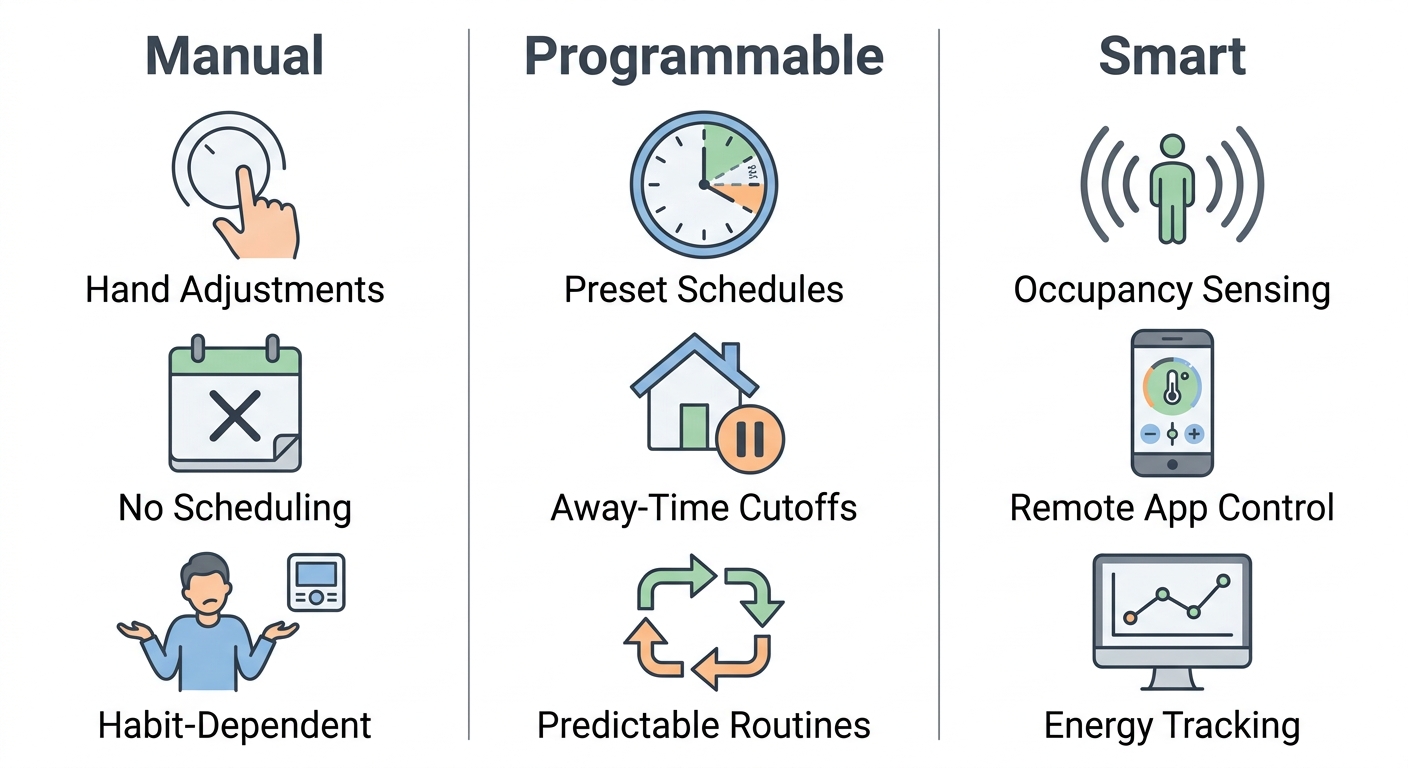
| Thermostat Type | How It Saves Energy | Best Fit For |
|---|---|---|
| Manual | Requires constant manual adjustments to avoid heating or cooling an empty home | Renters or households with very predictable, hand-kept routines |
| Programmable | Follows preset schedules to reduce heating and cooling when no one is home or asleep | Households with predictable routines and fixed occupancy patterns |
| Smart | Adds automatic occupancy and activity-based adjustments, adaptive recovery, remote smartphone control, and detailed energy tracking | Homeowners who want set-and-forget convenience and visibility into usage |
We frequently suggest that homes with regular schedules get programmed thermostats because they won’t waste energy and homeowners don’t have to pay close attention all the time. According to the US DOE, widespread smart thermostat adoption could save 56 trillion BTUs of energy annually nationwide.
3. Learning Schedules Without Manual Programming
If you wanted to save money on your energy bill before, the way you had to go about it was wrestle with a schedule on a regular old programmable thermostat. The only difference between a smart thermostat and a traditional manual model was that instead of constantly adjusting those settings manually, this thing could learn patterns at home based on what people did.
According to the U.S. Department of Energy, these devices can turn on and off based upon occupancy and activity patterns as well as user preferences. In contrast to having to manually enter programmed schedules, adaptive recovery technology will actually learn what it needs to do to move back and forth from a different temperature setting each time. So if you come into your house, it will reach a comfortable temperature without manual intervention. It eliminates the need to program schedules by hand. Comfort, savings, and no weekly programming to worry about. With widespread implementation of such smart thermostat systems estimated to produce significant annual energy savings, the convenience and savings are clear.
4. Remote Control While You’re Away
We may have changed our plans, but some things stay the same. We will still need the ability to control our heat from wherever we are. We don’t want to waste money keeping our houses warm if there’s nobody inside of them. With a smart thermostat, we can check and adjust the temperature from our phones even when we’re not in San Francisco.
According to U.S. Department of Energy, they allow for more than what can be programmed, since smart thermostats can be controlled remotely over internet, which can even be done from our phone in real time. Also, these devices give us real-time data on all our usage. The big deal that the smart models bring out is when someone leaves their house: remote access ensures we avoid wasted heating and cooling whenever we’re away from home.
While there are all those smart features, simple things can still be useful.
5. Simple Routines Still See Value
Programmable thermostats remain a smart choice even today, because they run on preset schedules that automatically lower heating and cooling when we’re away or asleep. That simple routine cuts energy waste without requiring constant manual adjustments or advanced features. When comparing a smart thermostat vs. a manual one for energy savings, the core advantage of programmable models is their reliability in following consistent patterns.
Smart thermostats build on this foundation by adding remote control, energy tracking, and occupancy sensing, which can fine-tune savings for homes with unpredictable routines. For households that keep regular schedules, a basic programmable unit delivers nearly the same benefits at a lower cost. The key is choosing the model that fits how we actually live rather than chasing extra features we won’t use.
These automated plans keep us from burning up unnecessary energy by setting temperatures according to our day-to-night schedule, keeping things comfy while we’re around and more frugal when we aren’t.
Steadier Comfort, Fewer Temperature Swings
We often tell homeowners in San Francisco that the difference between a smart thermostat and a manual one for energy savings isn’t just about the numbers—it’s about the comfort. The truth is, manual adjustments can leave rooms too warm or too cool for minutes at a time. Programmable and smart thermostats replace abrupt, reactive changes with gentle, schedule-based shifts that keep indoor conditions steady all day.
With smart thermostats, they learn just how long it takes for their temperature to hit what you want it to be, so they can ease up on temperatures before going overboard. Your smart thermostat automatically adjusts to your household’s routines—whether you’re asleep, at work, or hosting guests—so it keeps conditions consistent even as life changes. According to the U.S. Department of Energy, this kind of steady control prevents wasted heating and cooling when no one’s home, making your system work smarter, not harder.
Energy Tracking Reveals Hidden Waste
It is true that a smart thermostat will help maintain steady temperature levels but there is more. Energy usage data are provided as well that point out where we may be wasting heat when we should be getting cool, or vice versa, if we leave the house during working hours then return home to an overheated room, for example. What sets smart thermostats apart from manual models is that they self-adjust according to our routine habits without us having to lift a finger.
The U.S. Department of Energy says that if everyone used a smart thermostat, we’d be saving around 56 Trillion BTU of energy each year. The key will be for us to notice when our schedule doesn’t align with the thermostat setting and act accordingly based on the information at hand.
Check on your thermostat’s power reports often. If you see usage spike at odd hours, treat it as a signal to adjust schedules or call in a pro for a closer look.
8. Professional Installation Maximizes Performance
An intelligent thermostat does a lot more than turn on and off the heat. The feature-rich thermostat will do everything in its power to optimize energy consumption at home but can only deliver all the benefits once you’ve properly set it up. That means using the right settings for adaptive recovery and configuring the sensors properly, too.
The US Department of Energy says that if smart thermostats were installed across the country, they would save around 56 trillion BTU of energy annually through cutting out wasted heating and cooling while people weren’t home or sleeping. A professional will be able to install the device for you so it can learn how your family lives and automatically adjust its settings as needed. This means that there’s no need for you to lift a finger in order to be comfortable whilst still saving money at the same time. There’ll also be a rundown on what you can expect from the companion app, which should let you keep track of how much energy you’re consuming and make any changes whenever necessary.
Our crew is ready to help if you want your thermostat installed right the first time in San Francisco.
Frequently Asked Questions
How much can I realistically save on energy bills by switching from a manual to a smart thermostat?
Smart thermostats can reduce annual heating and cooling expenses by up to 10 percent according to the U.S. Department of Energy. Savings come from automatic adjustments based on occupancy and activity patterns, adaptive recovery technology, and remote control that prevents wasted energy when no one is home.
Why are smart thermostats considered more energy-efficient than manual or standard programmable models?
Smart thermostats use occupancy sensing, activity tracking, and adaptive recovery to adjust temperatures automatically without manual programming. They also provide remote control and energy tracking, which manual or basic programmable models lack, reducing unnecessary heating and cooling.
Do smart thermostats actually learn my schedule or do I still need to program them manually?
Smart thermostats learn your schedule by tracking occupancy and activity patterns, so manual programming is not required. Adaptive recovery technology also learns the most efficient way to reach your desired temperature, eliminating the need for weekly schedule adjustments.
Can a smart thermostat help me reduce my energy usage while I’m away from my San Francisco home?
Yes. Smart thermostats allow remote control via smartphone apps, letting you adjust temperatures in real time when you’re away. This prevents wasted heating or cooling in an empty home, reducing energy usage compared to manual or basic programmable models.
Is a smart thermostat worth the investment if I have a simple consistent daily routine?
A programmable thermostat following preset schedules can deliver nearly the same energy savings as a smart model for homes with predictable routines. Smart thermostats add convenience and fine-tuning benefits, but a basic programmable unit may be sufficient and more cost-effective for consistent schedules.
Choosing the Right Thermostat for Your San Francisco Home
Once your new thermostat is installed, the final step is choosing the model that fits how you live in San Francisco. Programmable thermostats follow preset schedules to reduce energy use when you’re away or asleep, while smart models add occupancy sensing, remote smartphone control, and energy tracking for even smarter savings.
Either option can cut wasteful heating and cooling, so the right thermostat is simply the one that matches your routine. Contact us at (415) 371-9413 in order to choose and install your ideal device based upon the way your life goes.
Upgrade Your Thermostat Today
You’ve now seen how smart and programmable thermostats cut energy waste by aligning heating and cooling with when you’re actually home or asleep. From adaptive recovery to energy tracking that reveals hidden waste, each option offers a different path to savings on your San Francisco utility bills. The right choice ultimately depends on your household’s routine and how much automation you want. Whichever model you choose, proper installation is what unlocks its full performance. Our team at San Francisco Expert HVAC has been helping homeowners in San Francisco, California with thermostats since 1997. We can also help you select the model that fits how you actually live. Call us at (415) 371-9413 to get started.