

Table of Contents
- Evaluating Carrier and Trane HVAC Systems for Your San Francisco Home
- Carrier vs Trane: Reliability, Efficiency, and What Sets Them Apart
- Benefits of Choosing Carrier or Trane for Your San Francisco Home
- How to Select the Right HVAC Brand for Your San Francisco Residence
- Best Practices for Installing and Maintaining Carrier and Trane Systems
- Making an Informed HVAC Investment for Your Home
Evaluating Carrier and Trane HVAC Systems for Your San Francisco Home
If San Francisco homeowners want to know which is better for their home, Carrier or Trane, then the straightforward answer would be that the better choice depends on whether they’re more concerned about long-term stability or cutting edge energy saving features. While both brands produce top quality units, there is a difference between what they offer as each brand caters differently towards its customers’ needs.
If you live in San Francisco’s warm, temperate environment with low heat needs and minimal air conditioning usage, it often matters less which company made your HVAC system than who installed it. Trane consistently rates high in long-term reliability, while Carrier has advanced efficiency features that may trim energy bills year after year. However, according to Clever Home Energy, installer quality matters more than which premium brand you choose, a point we emphasize in all our guidance. That is why we keep hammering home this idea.
In order to make up our minds between the two options above, we have to assess their reliability and their efficiency in direct comparison. Later you’ll be able to see how they measure against each other when it comes to score, power rating and real-world performance as well as all those other things. Most important is who’s going to put the equipment together for us here at home: a skilled local contractor. That may matter more than what that little logo says on the outside part of the unit.
Key Takeaways
- When homeowners are trying to figure out if Carrier or Trane is better, they’re looking at two top U.S.-based HVAC brands that offer high-end products.
- When you have to decide whether Carrier or Trane is better in San Francisco?
- To choose the perfect HVAC brand for your San Francisco house would be to weigh Carrier’s leadership when it comes to energy effectiveness versus Trane’s confirmed dependability.
- The quality of the long-term comfort provided as well as its efficiency starts in the install stage but doesn’t end there.
Carrier vs Trane: Reliability, Efficiency, and What Sets Them Apart
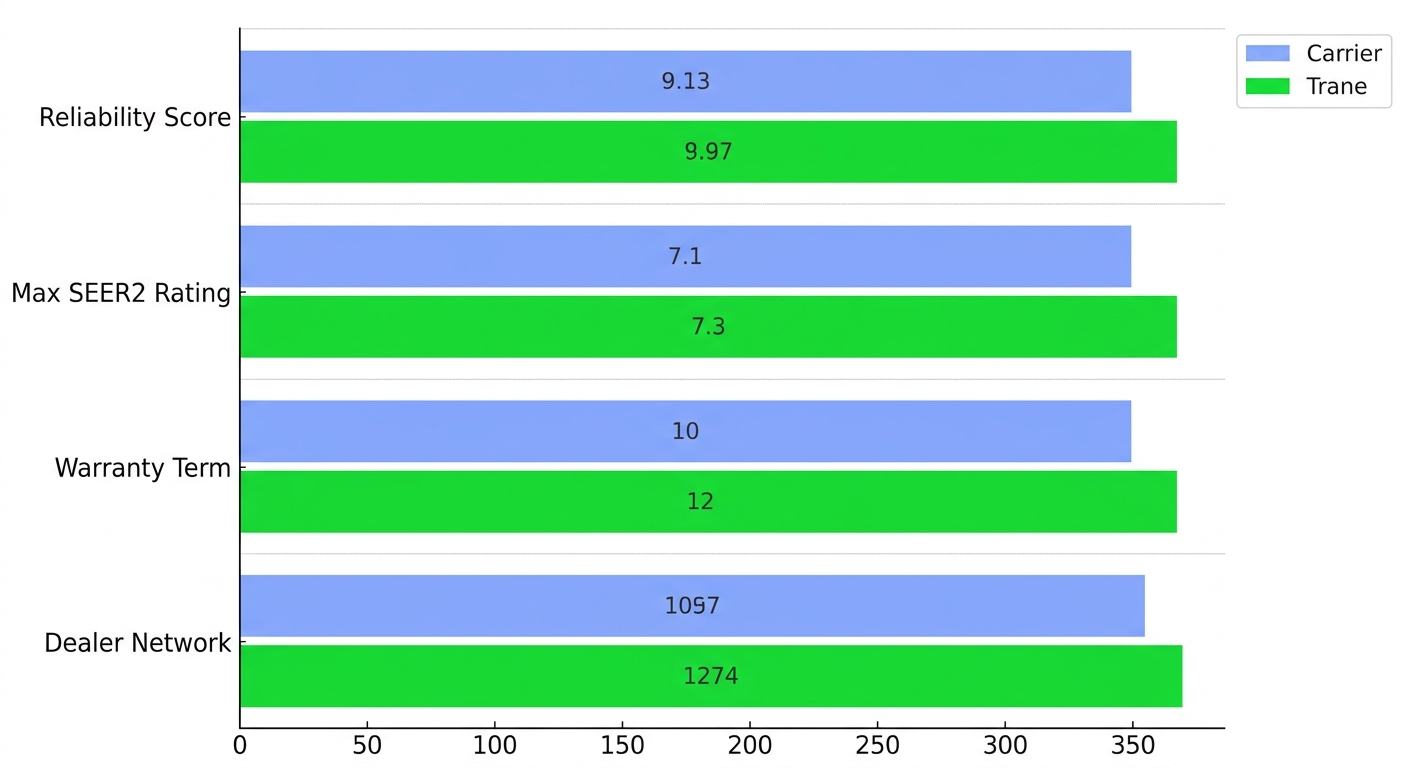
When homeowners are trying to figure out if Carrier or Trane is better, they’re looking at two top U.S.-based HVAC brands that offer high-end products. The following chart lists how both companies measure up when considering features related to home heating, cooling, and ventilation in the long-term.
| Factor | Carrier | Trane | Winner |
|---|---|---|---|
| Reliability Score | 8.9/10 | 9.1/10 | Trane |
| Energy Efficiency (SEER2) | Up to 26 SEER2 | Up to 22 SEER2 | Carrier |
| Warranty | 10-year parts, 90-day registration | 10-year parts, 60-day registration; selected models 12-year compressor | Tie |
| Dealer Network | Strong in metropolitan areas | More extensive in rural/suburban areas | Trane |
| Smart Features | Côr/Infinity Touch deeper third-party integration | Nexia/ComfortLink II ecosystem | Carrier |
Both offer good warranties, but which option you pick might depend on whether you want more fancy features or if you would prefer to go to the dealer for repairs.
Reliability and Durability
Independent expert analysis from Clever Home Energy rates Trane at 9.1 out of 10 for reliability compared to Carrier’s 8.9, crediting Trane’s consistent use of durable scroll compressor designs. Both manufacturers offer a standard 10-year parts warranty when you register the equipment within the required window—90 days for Carrier and 60 days for Trane—and selected Trane models include a 12-year compressor warranty. At San Francisco Expert HVAC, we see that even the most reliable brand can underperform without a meticulous installation, so we put as much emphasis on workmanship as on the equipment itself.
Energy Efficiency and SEER2 Ratings
Carrier’s Infinity series reaches up to 26 SEER2, while Trane’s highest-efficiency models top out around 22 SEER2. That difference translates into real savings: Independent estimates show annual cooling costs can drop by $480 to $650 when comparing a 26 SEER2 system to a basic 14 SEER2 unit. Trane’s high-efficiency options are still excellent performers. Still, if maximizing efficiency is your goal, Carrier’s top-tier heat pumps and air conditioners give you the greatest potential for energy savings without sacrificing comfort.
Smart Technology and Mechanical Features
Carrier’s Côr and Infinity Touch thermostats integrate more deeply with third-party smart home platforms than Trane’s Nexia/ComfortLink II ecosystem, giving you finer control over zoning, humidity, and scheduling from a single app. Mechanical features such as variable-speed compressors and sound-dampening cabinets are comparable across both lines, so the real performance differentiator is the quality of the installation. Understanding these differences helps you see why the right brand for your San Francisco home can lead to lasting comfort and savings.
Benefits of Choosing Carrier or Trane for Your San Francisco Home
When you have to decide whether Carrier or Trane is better in San Francisco? Each manufacturer does its part providing benefits to the homeowner.
| Benefit | Carrier | Trane | San Francisco Homeowner Takeaway |
|---|---|---|---|
| Long-Term Value & Maintenance Costs | High reliability score (8.9/10), SEER2 ratings up to 26, 10-year registered parts warranty with 90-day registration window | Top reliability score (9.1/10), proven scroll compressor design, 10-year parts warranty with select models offering 12-year compressor coverage | Both brands protect your investment with strong warranties. Trane’s superior reliability suits year-round coastal use, while Carrier’s efficiency gains reduce cooling costs during San Francisco’s warmer months. |
| Suitability for Older Homes & Unique Cooling Needs | Flexible model range with variable-speed technology that adapts to older ductwork and custom configurations | Extensive product lineup with modular designs engineered for straightforward retrofit installations | San Francisco’s many historic and architecturally distinct homes benefit from both brands when installed by a licensed, experienced professional who understands older building requirements and can tailor the system correctly. |
| Smart Features & Home Comfort Control | Côr and Infinity Touch platforms provide deep smart integration, remote access | Nexia/ComfortLink II system offers durable, user-friendly comfort management with reliable controls | Carrier leads in smart integration for tech-forward homeowners; Trane delivers dependable, straightforward control for those who prioritize simplicity and proven build quality. |
Long-Term Value and Maintenance Costs
Based on industry comparisons, Trane earns an overall rating of 9.1, just above Carrier’s mark of 8.9, largely due in part to its use of highly reliable scroll compressors. Carrier turns around and takes the high-efficiency crown, as its Infinity line can achieve ratings all the way up to 26 SEER2. Despite this, both brands offer the same 10-year registered parts warranty, albeit with different registration periods: while Carrier has 90 days, Trane offers only 60 days.
Suitability for Older Homes and Unique Cooling Needs
Both Carrier and Trane have some model lines which include variable speed technology as well as some that are more flexible to fit older duct work, or houses that did not originally have a duct system. The Carrier has a larger modulating range, making it better at dealing with some of the older floor plans. The Trane product line also includes some modular components designed specifically for retrofits where space will be limited requiring creativity on the part of the installer. An independent analysis emphasizes that the quality of the local dealer and the precision of the installation often play a more significant role in system performance than the brand name on the unit. In SF there are many old homes which don’t have much room inside them so finding a licensed installer that is experienced and knows about the building rules that govern them is going to help make sure your house is comfortable, yet looks nice.
Smart Features and Home Comfort Control
Smart integration is most advanced on Carrier’s Côr and Infinity Touch platforms, which also provide solid third-party device interoperability as well as remote management options for users. On the other end of the spectrum, Trane’s Nexia and ComfortLink II systems focus on reliable performance and easy operation.
How to Select the Right HVAC Brand for Your San Francisco Residence
To choose the perfect HVAC brand for your San Francisco house would be to weigh Carrier’s leadership when it comes to energy effectiveness versus Trane’s confirmed dependability. This guide goes into the methodical choice-making process made for the Bay region’s mild weather plus your own home’s specific needs.
Evaluating Your Home’s Heating and Cooling Requirements
First up, look at your home’s square footage. Look around at how well insulated it is and see what condition its ductwork is in.
Data show that the reliability grade of Trane is 9.1 out of 10 points while that of Carrier is around 8.9. Carrier’s Infinity Series has reached as high as 26 SEER2 rating which would help people cut their energy bill down whenever there’s milder conditions like in San Francisco.
The Role of Professional Installation in System Performance
For all Carrier and Trane products, a precise installation is essential—without it they will underperform. This includes having correct refrigerant charge, tight duct joints, and right airflow adjustments. Since our installation service company was founded back in 1997, serving San Francisco families, we’ve seen how a skilled installer can unlock every bit of a system’s rated performance.
They have lots of dealers located there as well, but they’re mostly based out of the larger towns for Carrier, while Trane has lots spread around locally.
Making the Final Decision: A Step-by-Step Guide
| Selection Step | What to Evaluate | Carrier Advantage | Trane Advantage |
|---|---|---|---|
| Assess home requirements | Capacity needs based on square footage, insulation, and existing ductwork in San Francisco’s mild climate. | Infinity series delivers exceptional efficiency up to 26 SEER2 to lower your energy bills. | Durable scroll compressors provide long-term reliability even in coastal air conditions. |
| Compare efficiency ratings | SEER2 numbers and annual energy savings potential. | Top-tier 26 SEER2 rating gives Carrier the efficiency edge. | Slightly lower maximum SEER2 (22) but robust, consistent performance across seasons. |
| Examine warranty coverage | Standard 10-year parts and compressor warranties, plus registration windows. | 10-year parts and compressor; a 90-day registration window offers flexibility. | 10-year parts, 12-year compressor on select models; 60-day registration window. |
| Check local dealer access | Availability of certified installers in the San Francisco metro area. | Extensive network of factory-authorized dealers in large cities. | Ample San Francisco-area representation, with a broader rural reach that is less critical here. |
| Prioritize installer quality | Technical certifications, local reputation, and verified customer reviews. | Performance depends on your chosen local contractor—choose carefully. | The same applies; installer skill outweighs brand differences for long-term satisfaction. |
The table shows that these two brands have more than sufficient credentials in themselves, but the thing that will make all the difference between them is the skill and ability of the contractors hired to fit your system.
When choosing the perfect brand and installer for your project, don’t forget that appropriate installation and continued upkeep will ensure optimal efficiency and durability.
Best Practices for Installing and Maintaining Carrier and Trane Systems
The quality of the long-term comfort provided as well as its efficiency starts in the install stage but doesn’t end there. The two companies listed here both offer top-notch products. Whether someone lives in San Francisco and has a Carrier which is known for being efficient, or another company like Trane which is known for its longevity, it’s important to make sure their equipment was installed properly and that they receive proper maintenance regularly.
Ensuring Proper Installation for Optimal Efficiency
It is not unusual for a Carrier or Trane system to arrive ready for installation at your home. However, some tips could ensure you take advantage of the benefits from these brands. Carrier offers customers their high-efficiency Infinity model, capable of up to a whopping 26 SEER2. However, if not properly configured according to correct duct size specifications, airflow won’t achieve those savings. As another option, we have Trane’s dependable machine rated 9.1/10 in long term durability, but installing will need to follow specific protocols to protect its scroll compressor and other components. Regardless, either brand’s new unit should only be set up by a properly licensed installer since the job may not provide as much energy-saving effects, or worst case scenario, could possibly void the warranty. The recommendation would be working together with the contractor which does a load calculation, ensures the refrigerant is properly charged, and tests static pressure so the systems operate properly right off the bat.
Regular Maintenance Schedules and Professional Tune-Ups
Routine maintenance helps both Carrier and Trane equipment run reliably and catch minor issues before they become expensive repairs. We recommend scheduling two seasonal inspections every year: an air-conditioning tune-up in spring before the cooling season, and a furnace check in early fall ahead of San Francisco’s chillier months. During a professional visit, a technician cleans coils, inspects electrical connections, checks refrigerant levels, and tests safety controls—steps that align with manufacturer guidance for either brand. Consistent service not only maintains energy efficiency but also creates a documented record of proper care, which may be required to uphold warranty terms. Homeowners who stick to this schedule typically enjoy lower utility bills and fewer unexpected breakdowns, extending the life of their investment.
Maximizing Warranty Coverage and Long-Term Performance
Warranty protection is a critical part of the value equation with Carrier and Trane systems. Data show that both manufacturers offer a 10-year parts and compressor warranty—provided the equipment is registered within the applicable window: 90 days for Carrier and 60 days for Trane. Missing these deadlines can reduce coverage to a base five-year warranty, leaving homeowners responsible for costly component repairs. Selected Trane models even extend the compressor warranty to 12 years when properly registered, underscoring the importance of timely action. We emphasize that registration is a one-time task that pays long-term dividends. Beyond registration, keeping records of annual professional maintenance helps substantiate any future claims. By combining prompt registration, diligent upkeep, and correct installation, San Francisco homeowners can enjoy reliable comfort and maximize the return on their HVAC investment.
Frequently Asked Questions
Is Carrier or Trane considered more reliable for residential HVAC systems?
Trane is considered more reliable, with a score of 9.1 out of 10 compared to Carrier’s 8.9. Trane’s edge comes from its consistent use of durable scroll compressor designs. Both brands are top premium manufacturers and offer strong warranties when registered.
Which brand Carrier or Trane is better suited for older homes with specific cooling needs?
Both Carrier and Trane can be well suited for older homes when installed by a knowledgeable professional. Carrier’s variable-speed technology and larger modulating range adapt effectively to older floor plans and ductwork. Trane offers modular components designed for retrofits in limited spaces, ensuring flexible installation.
How much does installation quality impact the performance of Carrier versus Trane equipment?
Installation quality has a significant impact on performance for both brands, often outweighing the specific brand choice. Precise installation with correct refrigerant charge, sealed ductwork, and proper airflow is essential to achieve the rated efficiency and durability of Carrier or Trane equipment. A skilled contractor unlocks each system’s full potential.
Should I prioritize Carrier’s smart technology or Trane’s mechanical durability for my home?
Your decision should be based on personal priorities. If smart home integration and remote control are important, Carrier’s Côr and Infinity Touch platforms offer deeper third-party connectivity. If long-term mechanical durability is the priority, Trane’s 9.1 reliability score and robust scroll compressors make it the stronger choice.
Making an Informed HVAC Investment for Your Home
Once you understand how to install and maintain high-end systems, the question “is carrier or trane better” becomes less about the brand and more about your home’s unique requirements. Both manufacturers deliver exceptional reliability and efficiency. An industry 2026 industry comparison shows Trane earning a 9.1 reliability score to Carrier’s 8.9, while Carrier’s Infinity series reaches up to 26 SEER2 for top-of-the-line energy savings. Each brand backs its equipment with a 10-year parts warranty, provided the product is registered within the manufacturer’s deadline—60 days for Trane, 90 days for Carrier.
But the single most important takeaway is that installation quality dictates long-term comfort more than the name on the cabinet. A skilled, factory-authorized technician in the San Francisco area will size, place, and commission your system correctly, maximizing both durability and efficiency.
We have served San Francisco homeowners since 1997 with 24-hour availability and personalized service. If you’re weighing your options, call San Francisco Expert HVAC at (415) 371-9413 or stop by 1725 Montgomery St, San Francisco, CA 94111. We’ll evaluate your home and match the right equipment to your comfort priorities and budget.
Get San Francisco HVAC Expert Advice
Now that you’ve learned how Carrier and Trane compare on reliability, efficiency, and smart features, the next step is finding a qualified installer. Both manufacturers offer 10-year warranties when registered, and Carrier’s SEER2 ratings can reach up to 26, while Trane scores 9.1 in reliability. The local installer’s expertise, as highlighted in our comparison, is what truly unlocks these benefits. San Francisco Expert HVAC has served the Bay Area since 1997, focusing on professional installation and personalized service. We can evaluate your home’s specific needs and guide you to the right choice. Call us at (415) 371-9413 or visit our website to schedule your appointment today. Make the informed decision your home deserves with help from a local expert.
Get San Francisco HVAC Expert Advice